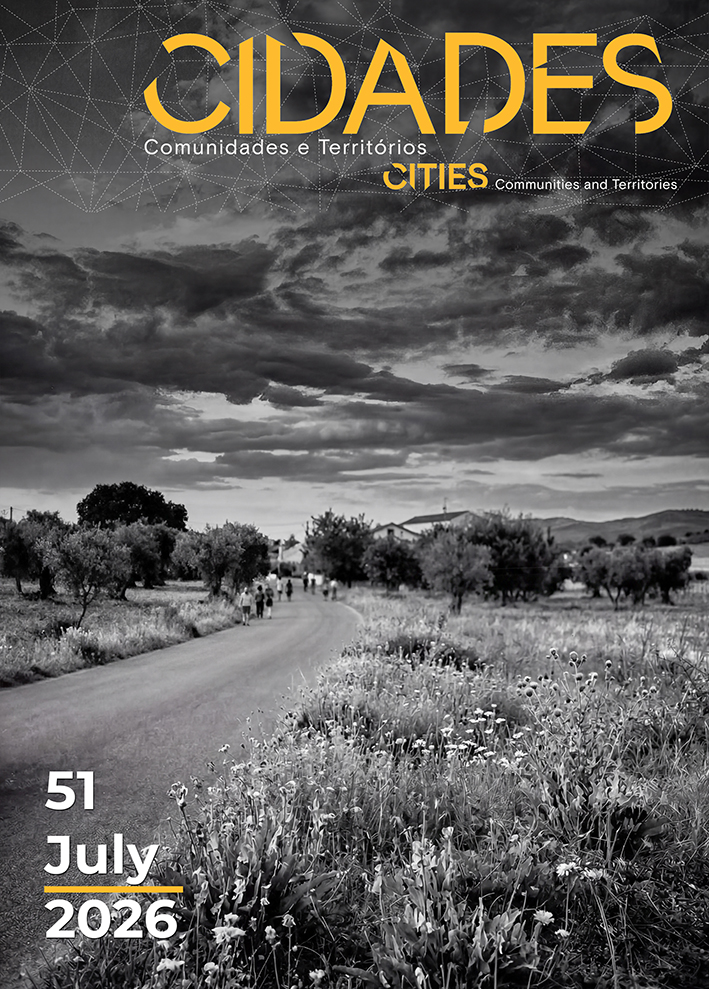
Barcelona’s Rec Comtal: the multiple lives of a millenary water infrastructure
Keywords:
heritage, infrastructure, urban planning, neighbourhood activismAbstract
The Rec Comtal is a canal that provided water to Barcelona for a thousand years, until it was disconnected from the water supply network in the late 20th century. Nevertheless, a small part of it continued to carry water, and remained inconspicuously active through informal uses (recreational and agricultural). The rediscovery of the canal in the 21st Century, initially in the form of archaeological remains, has made this hydraulic infrastructure newly visible and increasingly present in the social and political life of the city. It has been reconceptualized as a future “green infrastructure”, reclaimed as part of the historical memory of some neighbourhoods, and activated as a political ally in the resistance against certain urban developments. This article explores the multiple ways in which the Rec has resurfaced in the last two decades. It then zooms into an area - between Can San Joan and Vallbona - which was renovated following grassroots mobilizations, which anticipates the redesign of the Rec as a new green infrastructure for the city, and where this vision has produced friction with existing recreational uses such as bathing, now deemed inappropriate. Drawing from the anthropology of infrastructures literature we conceptualize the Rec as an infrastructure capable of channelling things other than water, including imaginaries, affect, promises, desires and moral behaviours.
References
Alcántara, A., Aranda, M. Morales, E. (2019). El Rec Comtal: un gran equipament invisible. Quaderns d’Educació Social, 21, 104–109.
Anand, N. (2017). Hydraulic City: Water and the Infrastructures of Citizenship in Mumbai. Duke University Press Books.
Andreu, M. (2008). Moviments socials i crítica al ‘model Barcelona’. De l’esperança democràtica de 1979 al miratge olímpic de 1992 i la impostura cultural del 2004. Scripta Nova: Revista Electrónica de Geografía y Ciencias Sociales, XII.
Balibrea, M. P. (2001). Urbanism, culture and the post-industrial city: Challenging the ‘Barcelona model’. Journal of Spanish Cultural Studies, 2(2), 187–210. https://doi.org/10.1080/1463620012008517
Ballestero, A. (2019). The Anthropology of Water. Annual Review of Anthropology, 48, 405–421. https://doi.org/10.1146/annurev-anthro-102218-011428
Bianchi, I. (2023). The commonification of the public under new municipalism: Commons–state institutions in Naples and Barcelona. Urban Studies, 60(11), 2116–2132. https://doi.org/10.1177/00420980221101460
Blakeley, G. (2005). Local Governance and Local Democracy: The Barcelona Model. Local Government Studies, 31(2), 149–165. https://doi.org/10.1080/03003930500031959
Capel, H. (1996). La rehabilitación y el uso del patrimonio histórico industrial. Documents d’Anàlisi Geogràfica, 29, 19–50.
Capel, H. (1999). El Rec Comtal y otros canales mediterráneos. Biblio 3w: revista bibliográfica de geografía y ciencias sociales, 4(157). https://www.ub.edu/geocrit/b3w-157.htm
Capel, H. (2007). El debate sobre la construcción de la ciudad y el llamado ‘modelo Barcelona’. Scripta Nova: Revista Electrónica de Geografía y Ciencias Sociales, 9(233), 1–59.
Carse, A., & Kneas, D. (2019). Unbuilt and Unfinished: The Temporalities of Infrastructure. Environment and Society, 10(1), 9–28. https://doi.org/10.3167/ares.2019.100102
Centre d’Estudis Ignasi Iglèsias (ed.) (2018). El Rec Comtal: Passat, present i futur. Barcelona: Centre d’Estudis Ignasi Iglèsias.
Corredera, A. (2023). “Biodiversity viewpoints. Environmental restoration of the Rec Comtal area by Carles Enrich”. Metalocus. https://www.metalocus.es/en/news/biodiversity-viewpoints-environmental-restoration-rec-comtal-area-carles-enrich
De Cesari, C. (2010). Creative heritage: Palestinian heritage NGOs and defiant arts of government. American Anthropologist, 112(4), 625–637.
Degen, M., & García, M. (2012). The Transformation of the ‘Barcelona Model’: An Analysis of Culture, Urban Regeneration and Governance. International Journal of Urban and Regional Research, 36(5), 1022–1038. https://doi.org/10.1111/j.1468-2427.2012.01152.x
Delgado, M. (2007). La ciudad mentirosa. Fraude y miseria del ‘Modelo Barcelona’. Los Libros de la Catarata.
Douglas, M. (2003). Purity and Danger: An Analysis of Concepts of Pollution and Taboo. Routledge.
Ganau, J. (2008). Reinventing Memories: The Origin and Development of Barcelona’s Barri Gotic, 1880-1950. Journal of Urban History, 34(5), 795–832.
Geagea, D., Kaika, M., & Dell’Angelo, J. (2024). From austericide to recommoning: Counter-imaginaries for democratizing water governance. Ecology and Society, 29(4). https://doi.org/10.5751/ES-15267-290408
Graham, S., & McFarlane, C. (Eds.). (2014). Infrastructural Lives: Urban Infrastructure in Context. Routledge.
Guy, S., Marvin, S., Medd, W., & Moss, T. (Eds.). (2010). Shaping Urban Infrastructures: Intermediaries and the Governance of Socio-Technical Networks. Earthscan.
Guàrdia, M. (Ed.). (2011). La revolució de l’aigua a Barcelona: De la ciutat preindustrial a la metròpoli moderna, 1867-1967. MUHBA; Ajuntament de Barcelona.
Guàrdia, M., Rosselló, M., & Garriga, S. (2014). Barcelona’s water supply, 1867–1967: The transition to a modern system. Urban History, 41(3), 415–434.
Krause, F. (2021). Water and Materiality. In Oxford Research Encyclopedia of Anthropology. https://doi.org/10.1093/acrefore/9780190854584.013.473
Loftus, A., March, H., & Purcell, T. F. (2019). The political economy of water infrastructure: An introduction to financialization. WIREs Water, 6(1), e1326. https://doi.org/10.1002/wat2.1326
March, E. H. (2016). El Rec Comtal: 1000 anys d’història. Ajuntament de Barcelona; Viena Edicions.
March, H. (2015). Taming, controlling and metabolizing flows: Water and the urbanization process of Barcelona and Madrid (1850–2012). European Urban and Regional Studies, 22(4), 350–367. https://doi.org/10.1177/0969776412474665
March, H., Satorras, M., Saurí, D., & Swyngedouw, E. (2019). The deadlock of metropolitan remunicipalisation of water services management in Barcelona. Water Alternatives, 12(2), 360–379.
Martín Pascual, M. (1999). El Rec comtal (1822-1879): La lluita pel control de l’aigua a la Barcelona del segle XIX. Rafael Dalmau.
Mason, O., Sarma, J., Sidaway, J. D., Bonnett, A., Hubbard, P., Jamil, G., Middleton, J., O’Neill, M., Riding, J., & Rose, M. (2023). Interventions in walking methods in political geography. Political Geography, 106, 102937. https://doi.org/10.1016/j.polgeo.2023.102937
McDonald, D. A., & Swyngedouw, E. (2019). The new water wars: Struggles for remunicipalisation. Water Alternatives, 12(2), 322–333.
Monclús, F. J. (2003). The Barcelona model: And an original formula? From ‘reconstruction’ to strategic urban projects (1979-2004). Planning Perspectives, 18(4), 399–421. https://doi.org/10.1080/0266543032000117514
Muehlebach, A. (2023b). Life as debt, or debt to life? Water, finance and infrastructure. Economy and Society, 52(4), 675–696. https://doi.org/10.1080/03085147.2023.2287885
Peutz, N. (2018). Islands of heritage: Conservation and transformation in Yemen. Stanford University Press.
Robertson, I. J. M. (2016). Heritage from below. Routledge.
Sansi, R. (2018). Rec Comtal: Infraestructures i imaginari de l’aigua a Barcelona. Revista d’etnologia de Catalunya, 43, 235–246.
Schnitzler, A. von. (2008). Citizenship Prepaid: Water, Calculability, and Techno-Politics in South Africa. Journal of Southern African Studies, 34(4), 899–917. https://doi.org/10.1080/03057070802456821
Varo, A., Hamou, D., Méndez de Andés, A., Bagué, E., & Aparicio Wilhelmi, M. (2023). Commoning urban infrastructures: Lessons from energy, water and housing commons in Barcelona. Journal of Urban Affairs, 47(2), 566–585. https://doi.org/10.1080/07352166.2023.2190025
Wagner, J. R. (Ed.). (2013). The Social Life of Water. Berghahn Books.
Downloads
Published
Issue
Section
License
Copyright (c) 2025 Isaac Marrero Guillamón, Iván Ramírez-Osorio

This work is licensed under a Creative Commons Attribution-NonCommercial-NoDerivatives 4.0 International License.
CIDADES, Comunidades e Territórios by DINÂMIA'CET-Iscte is licensed under a CC-BY licence.