"We Can’t Die Here by this Wall"
Public buildings between heritage and urban development in Miranda do Douro, Portugal
Keywords:
heritage, public buildings, urban heritagization, urban history, 20th centuryAbstract
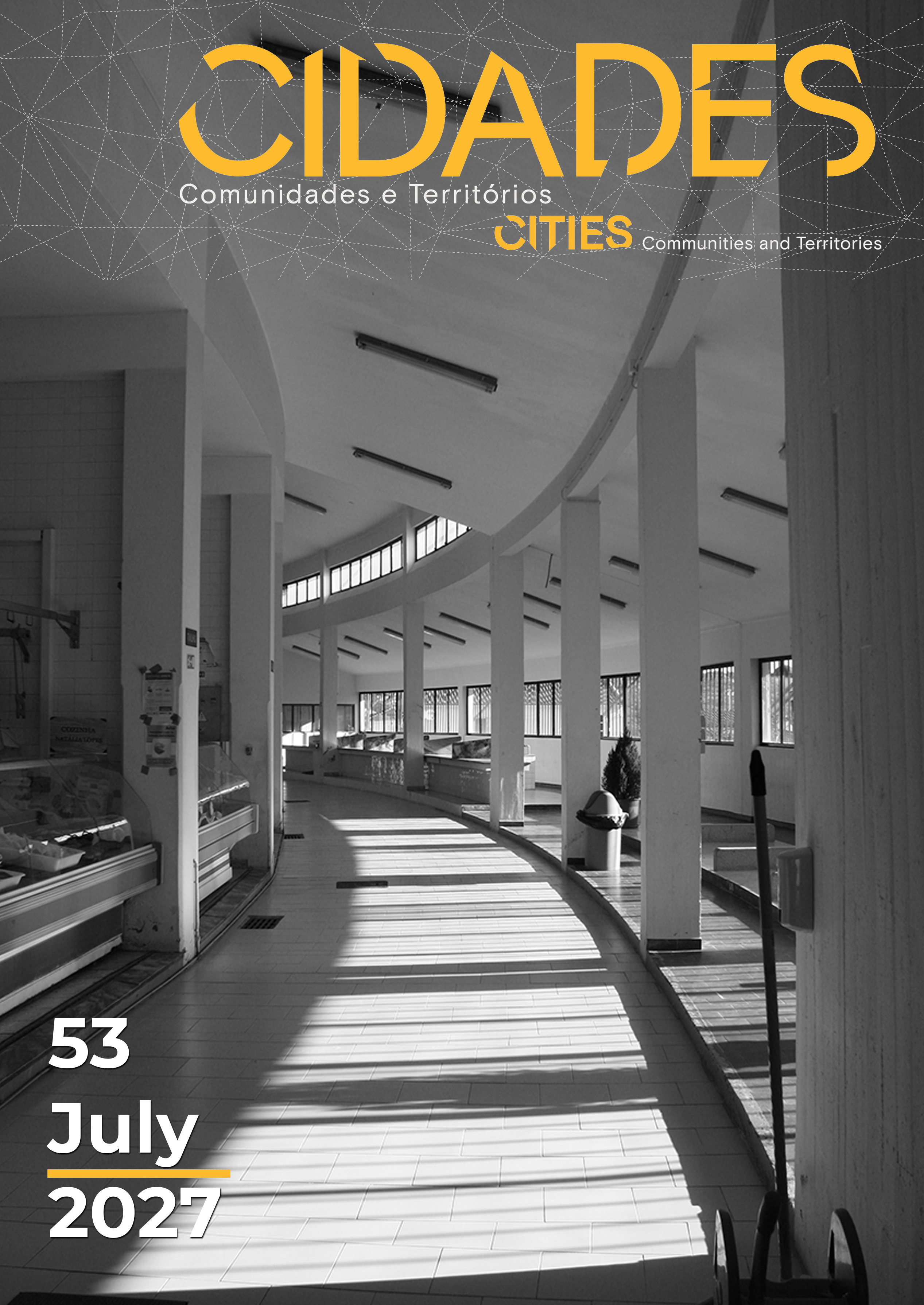
This article examines how the mid-twentieth-century conflict between heritage and urban development shaped the current urban landscape of Miranda do Douro, Portugal. It traces the production of the historic centre through the histories of three essential public buildings: the fire station, municipal market, and primary school. The research draws upon primary sources from local and central archives, construction records, and meetings’ minutes, complemented by oral testimonies collected locally - including the voices from people of different generations, professions, socioeconomic backgrounds, and diverse connections to the city. By setting official accounts in dialogue with personal narratives, the study contrasts institutional understandings of heritage with lived experiences, revealing how heritage operates as a historical process embedded in everyday life and central to urban development. The findings show that central authorities, prioritizing a conservation strategy aimed at tourism, invoked heritage laws to paralyze the construction of public buildings within the walled town. The consequent relocation of these buildings created a new urban centrality outside the historic area, which became the dominant space of residence and collective life. The displacement of these collective facilities from the historic core has weakened the social fabric of the old center, now oriented towards tourism. Paradoxically, heritage conservation policies have accelerated the decline in the maintenance of historical buildings and produced a loss of vitality in this area.
References
Archival documentation
ADB. Miranda do Douro, 1957.
Miranda do Douro’s Municipal Archive, Arquivo Municipal de Miranda do Douro (AMMD). Quartel dos Bombeiros Voluntários 1968-82 (QBV). Preliminary Project, Jul. 1968.
AMMD. MM. Hortas da Silva’s appraisal of the Market’s project, 11 Mar. 1969.
Archives of the General Directorate of Territory - Arquivo da Direção-Geral do Território (ADGT). Construção do Quartel dos Bombeiros Voluntários de Miranda do Douro 1966–93 (CQBV). Hortas da Silva’s appraisal of the preliminary project, 27 Aug. 1969.
AMMD. EP. Schools with Special Projects, 20 Dec. 1969.
AMMD. EP. JNE’s opinion on the location of the Primary School, 15 Mar. 1971.
AMMD. EP. Sanches da Gama’s Information, 16 January 1976.
ADGT. CQBV. Minutes of the Miranda Do Douro Town Council Meeting, 4 Apr. 1977.
ADGT. CQBV. Garcia’s letter to the Mayor, 12 Jul. 1977.
ADGT. CQBV. DGT’s Opinion on the Location of the Fire Station, 23 Aug. 1977.
ADGT. CQBV. Declaration of strike, 4 Sep. 1977.
ADGT. CQBV. IPCPN’s opinion on the location of the Fire Station, 13 Jul. 1978.
ADGT. CQBV. Inauguration Programme of the Fire Station, 17 Oct. 1982.
AMMD. MM. Transnorte’s letter to the Mayor, 17 Dec. 1982.
ADGT. CQBV. LNEC’s Stability Report, 3 Nov. 1987.
Bibliography
Agarez, R. (2019). Obras Públicas e "Melhoramentos" Locais: Entre Lisboa e o País (Real). In J. Brites, L. Correia (eds.). Obras Públicas no Estado Novo. Imprensa da Universidade de Coimbra
Agarez R. C., Mehnert Pascoal A., Herrera-Pineda I. (2025) Towards a Public Architectural History: Collective-Use Facilities and Community Engagement in Portugal and Spain. International Public History, 8(2), 69–82.
Ashworth, G. (2011). Preservation, conservation and heritage: Approaches to the past in the present through the built environment. Asian Anthropology, 10(1), 1–18.
Ashworth, G. (2014). Heritage and economic development: Selling the unsellable. Heritage & Society, 7(1), 3–17.
Bártolo, C. (2021). O Secretariado da Propaganda Nacional e a construção de um gosto através da pesquisa etnográfica. Polis, 2(4), 87–170.
Câmara Municipal de Miranda do Douro (CMMD). (1984). Regulamento para o Centro Histórico.
Choay, F. (2010). A alegoria do património.
Correia, L. M. (2019). Monumentos num País de Conto de Fadas. In J. Brites, L. Correia (eds.). Obras Públicas no Estado Novo. Imprensa da Universidade de Coimbra
Cunha, L. (2020). O Pioneirismo do I Congresso Nacional de Turismo (1936). In A. Pires, C. Cadavez, J. Henriques (Eds.). Turismo, História, Património e Ideologia. Câmara Municipal de Cascais, Universidade Nova de Lisboa.
Decreto de 16 de junho de 1910. (1910, 16 de junho). Diário do Governo n.º 136.
Franquesa, J. (2013). On keeping and selling: The political economy of heritage making in contemporary Spain. Current Anthropology, 54, 346–369.
Gabinete Técnico Local (GTL). (2007). Plano de Pormenor de Salvaguarda do Centro Histórico de Miranda do Douro. Câmara Municipal de Miranda do Douro.
Gosseye, J., Stead, N., & van der Plaat, D. (Eds.). (2019). Speaking of buildings: Oral history in architectural research. Princeton Architectural Press.
Hayden, D. (1995). The Power of Place - Urban Landscapes as Public History, The MIT Press.
Harvey, D. (2013). Rebel cities: From the right to the city to the urban revolution.
Herzfeld, M. (2015). Heritage and the right to the city: When securing the past creates insecurity in the present. Heritage & Society, 8(1), 3–23.
Hidro-eléctrica do Douro SARL (HED). (1958). Aproveitamento Hidroeléctrico do Douro Internacional: Escalão de Miranda.
Instituto Nacional de Estatística (INE). (2022). Censos 2021, XVI Recenseamento Geral da População, VI Recenseamento Geral da Habitação: Resultados definitivos.
Katapidi, I. (2023). The role of conservation policies in local understandings of heritage in living heritage places: A Greek testimony. International Journal of Heritage Studies, 29(4), 275–293. Lei n.º 2123. (1964, 14 de dezembro). Diário do Governo n.º 291/1964, Série I. https://diariodarepublica.pt/dr/detalhe/lei/2123-1964-535034
Meskell, L. (2015). Global Heritage: A Reader. Wiley-Blackwell.
Marques Alves, V. (1997). Os etnógrafos locais e o Secretariado da Propaganda Nacional. Um estudo de caso, Etnográfica, 1 (2).
Neto, M. J. (2022). The restoration of Monuments in Portugal: From Athens 1931 to Venice 1964 Charters. Artison, 12, 38-46.
Oliveira Martins, G. (2020). À Procura de um Turismo Português: Nota Brevíssima. In Pires, A., Cadavez, C., Henriques, J. (Eds.) Turismo, História, Património e Ideologia. Câmara Municipal de Cascais, Universidade Nova de Lisboa.
Ordem de 9 de agosto de 1957. (1957, 9 de agosto). Diário do Governo n.º 185, Série II.
Paek, Y., & Zoh, M. (2025). The role of heritage in the context of dictatorship, then democracy: South Korea’s heritage management between 1961 and 1993. Heritage & Society, 18(2), 210–224.
Prista, M. (2015). From displaying to becoming national heritage: the case of the Pousadas de Portugal. National Identities, 17(3), 311-331.
Quintas, A. (2020). As Edições de Turismo do SPN/SNI sob António Ferro: Cristalização de uma imagem. Turismo, História, Património e Ideologia. Câmara Municipal de Cascais, Universidade Nova de Lisboa.
Resolução do Conselho de Ministros n.º 104/95. (1995, 13 de outubro). Diário da República n.º 237/1995, Série I-B. https://diariodarepublica.pt/dr/detalhe/resolucao-conselho-ministros/104-664075
Rezaei, N., Alborzi, G., & Alilou, L. (2019). Transformation of historic neighborhoods: How tourism is changing the historic centre of Kashan, Iran. Heritage & Society, 12(2–3), 176–196.
Ribeiro, C. (2020). Turismo em Portugal. E se António Ferro não tivesse existido? In A. Pires, C. Cadavez, J. Henriques (Eds.) Turismo, História, Património e Ideologia. Câmara Municipal de Cascais, Universidade Nova de Lisboa.
Santos Silva, A. (2024). The Symbolic Politics of Cultural Heritage - A view from Portugal. Sociologia, Problemas e Práticas, 108, 9-21.
Scobey, D. (2002). Empire city: The making and meaning of the New York City landscape.
Silva, L. (2012). Built heritage-making and socioeconomic renewal in declining rural areas: evidence from Portugal. Etnográfica, 16(3).
Smith, L. (2006). Uses of heritage. Routledge.
Tostões, A. (2019). A Monumentalidade como Programa Político e Simbólico do Estado Novo. In J. Brites, L. Correia (eds.). Obras Públicas no Estado Novo. Imprensa da Universidade de Coimbra
Ünlü, T. (2019). Urban memory and planning: investigating the use of oral history, European Planning Studies, 27(4), 802–817,
Winter, T. (2013). Clarifying the critical in critical heritage studies. International Journal of Heritage Studies, 19.
Downloads
Published
Issue
Section
License
Copyright (c) 2026 Catarina Ruivo, Ivonne Herrera-Pineda

This work is licensed under a Creative Commons Attribution 4.0 International License.
CIDADES, Comunidades e Territórios by DINÂMIA'CET-Iscte is licensed under a CC-BY licence.