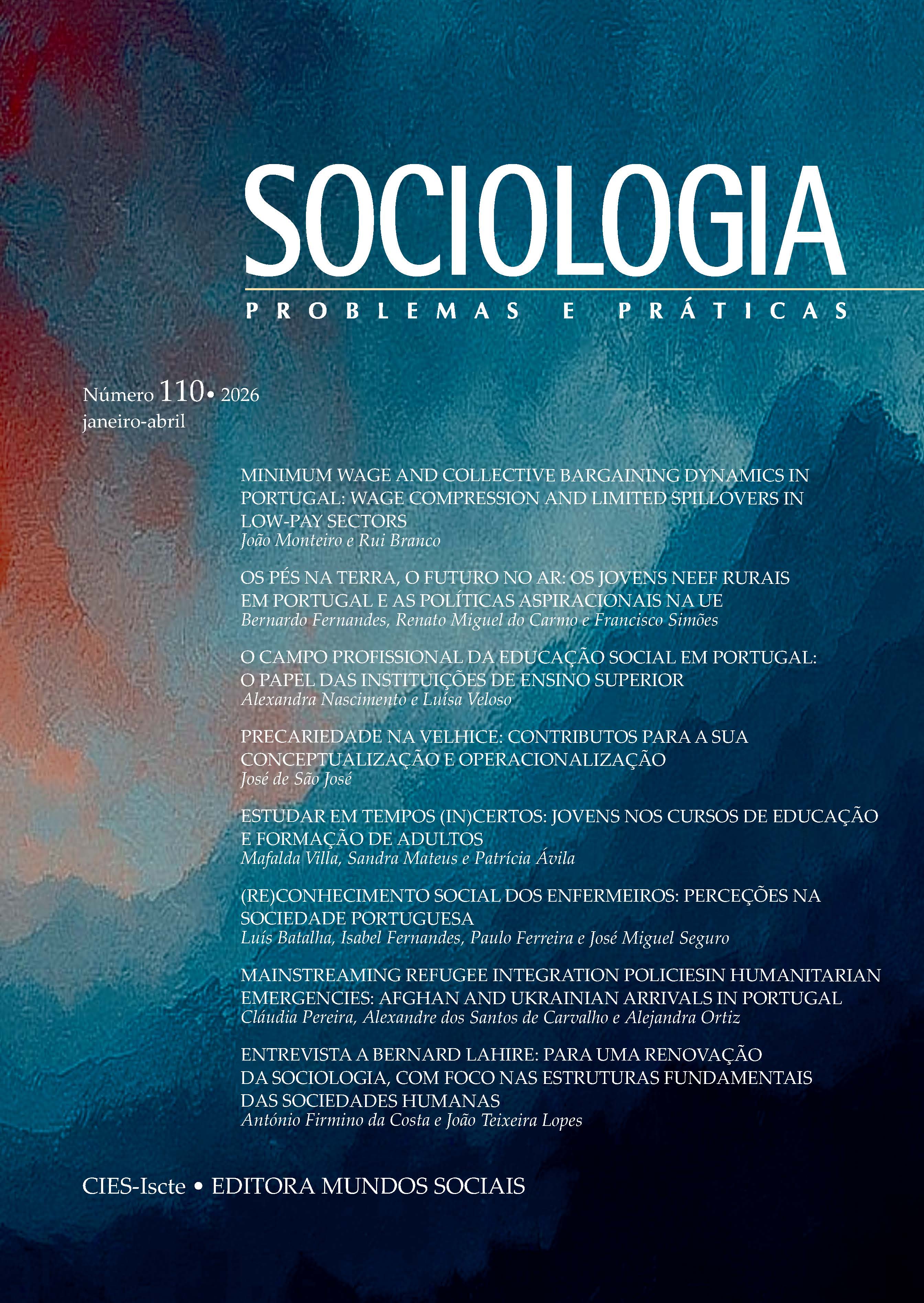
Interview with Bernard Lahire: towards a renewal of sociology, centered on the fundamental structures of human societies
DOI:
https://doi.org/10.7458/SPP202611046134Keywords:
fundamental structures, social invariants, social laws, comparative method, scientific realism, social sciences of the livingAbstract
Bernard Lahire, a highly regarded French sociologist of international renown, has made a series of remarkable advances in sociology and put forward innovative proposals of great scientific interest. In this interview, he discusses some of the cornerstones of a new programme for the renewal of sociology that he has been developing, grounded in an epistemological perspective of scientific realism and centered on researching the fundamental structures of human societies. It is an approach with a broad theoretical scope and a wide interdisciplinary reach, drawing on comparisons between societies and between species, and broadening the cognitive horizon to what the author calls the “social sciences of the living”. In this way, sociology can go beyond merely describing socio-cultural and historical “variations” to also identify social “invariants”, namely those condensed into general social laws. This also opens up the possibility of decisively raising the scientific status of sociology.
Downloads
Published
Issue
Section
License
Copyright (c) 2026 António Firmino da Costa, João Teixeira Lopes

This work is licensed under a Creative Commons Attribution 4.0 International License.
Authors who publish in this Journal must agree the following terms and conditions:
- Authors retain copyright and grant the Journal the right to first publication, while simultaneously agreeing to a Creative Commons Attribution License, which allows others to share their work on condition that they cite the original author(s) and recognise that the latter’s work was first published in this Journal.
- Authors are authorised to enter into additional contracts separately, for non-exclusive distribution of the version of the work that is published in this Journal (e.g. publication in an institutional repository or as a book chapter), subject to recognition of initial publication in this Journal.