Latest complete issue
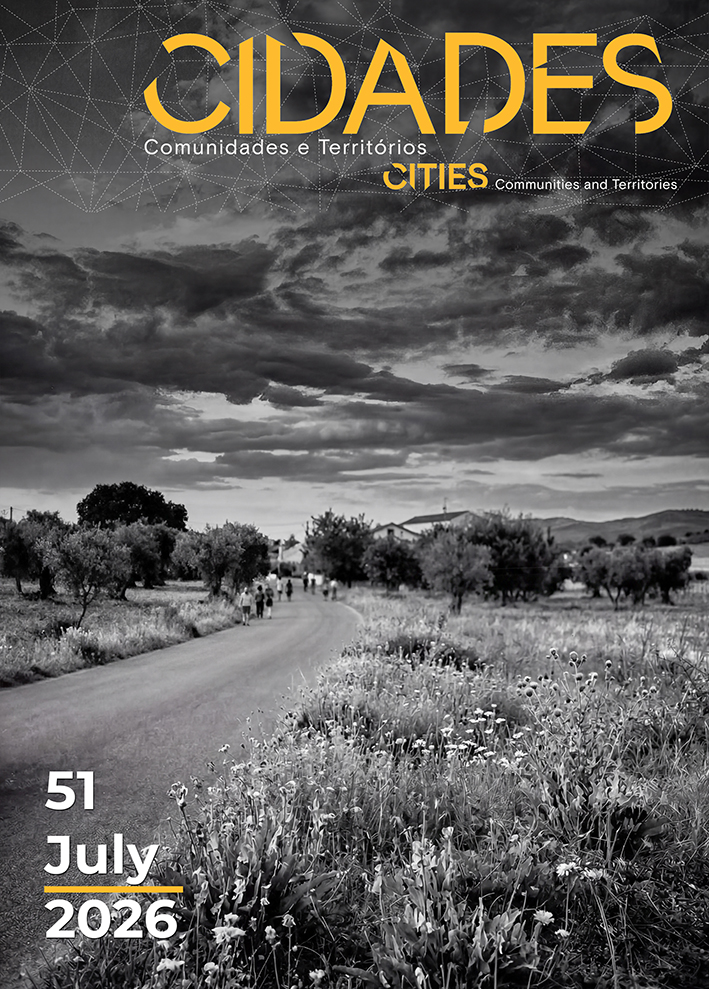

Presents, analyzes and promotes discussion about important policy issues of socially, politically or economically relevance in urban studies, for academic, policy-maker and general audiences.
The Policy Briefs section addresses questions of development policy on the scope of urban studies. Publications under this format constitute a key tool to present research and recommendations to a non-specialized audience, serving as a channel to provide evidence-based policy advice to help readers make informed decisions.
In this sense, Policy Briefs translate research findings into plain language and draw clear links to policy initiatives. Therefore, Policy Briefs are clear and concise documents that focus on a single topic, include recommendations aimed at policymakers, practitioners, and representatives of urban planning and managing entities. Besides, the series also addresses everyone interested in the issues analysed.
From 2026, CIDADES, Comunidades e Territórios and all its contents are licensed under CC BY 4.0. To view a copy of this license, visit https://creativecommons.org/licenses/by/4.0/.
In accordance with the General Data Protection Regulation 2016/679, CIDADES, Comunidades e Territórios, through its publishing institution DINÂMIA'CET-IUL, Instituto Universitário de Lisboa, acts as the Controller of the personal data you provide, and these data will be entered into a register of the processing activity owned by the company.
The names and email addresses entered in this journal site will be used exclusively for the stated purposes of this journal and will not be made available for any other purpose or to any other party.
Under no circumstances will the data be transferred among these companies without your express consent, and you will always be informed about the company or companies which will process your data through the particular terms and conditions of the recruitment process in which you take part.
Your data will be protected with security measures of a technical and organizational nature in order to guarantee the safety of personal information and prevent their non-authorized modification, loss, processing or access, in the light of the scope, context and purposes of the processing; the state of the technique and the existing risks, such as control proceedings for the safety of the information systems. When determining these measures, criteria such as the scope, context and purposes of the processing have been taken into account, as well as the state of the technique and the existing risks.


Journal specifications:
CIDADES, Comunidades e Territórios.
Triannual open access journal.
https://revistas.rcaap.pt/cct/
Owner: ISCTE, Instituto Universitário de Lisboa (NIPC 501 510 184), com financiamento da Fundação para a Ciência e a Tecnologia.
Published by (editorial office headquarters) DINÂMIA'CET-Iscte, Centro de Estudos sobre a Mudança Socioeconómica e o Território, an ISCTE-IUL research unit.
Address: Av. das Forças Armadas, Edifício ISCTE, Sala 2W4-d, 1649-026 Lisboa, Portugal
Editor: Maria Assunção Gato
N.º ERC 127742
ISSN: 2182-3030

Indexed by: Scopus, SciELO Citation Index, OpenEdition, SciELO, Diamond Discovery Hub, DOAJ, EBSCO Publishing, Latindex, IBSS - International Bibliography for the Social Sciences, Google Scholar, Redib.


From 2026, CIDADES, Comunidades e Territórios is licensed under CC BY 4.0

Although CCT is not a member of the Committee on Publication Ethics (COPE), its Editorial Board decided to adhere to the principles of the COPE Code of Conduct, from January 1st 2019 onwards.
