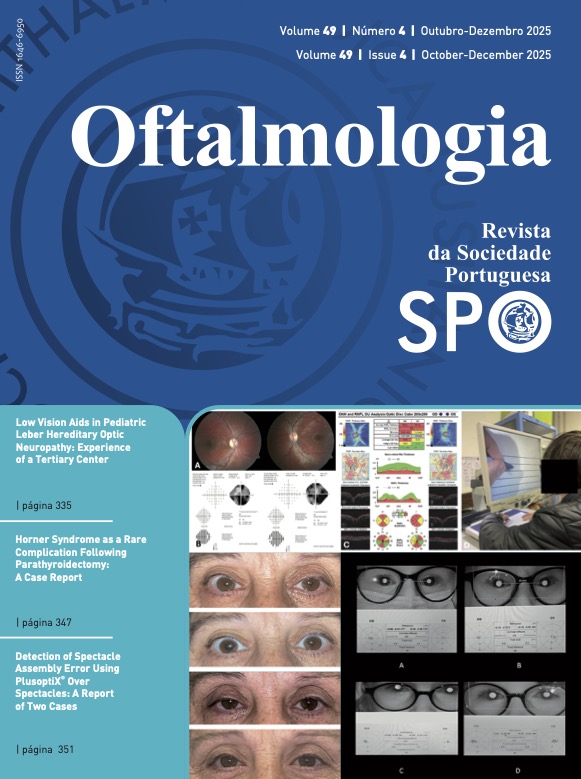
Auxiliares de Baixa Visão na Neuropatia Óptica Hereditária de Leber Pediátrica: Experiência de um Centro Terciário
DOI:
https://doi.org/10.48560/rspo.38329Palavras-chave:
Acuidade Visual, Atrofia Óptica Hereditária de Leber/tratamento, Criança, Dispositivos ÓpticosResumo
INTRODUÇÃO: A neuropatia óptica hereditária de Leber (LHON) é a doença mitocondrial hereditária mais comum. Embora afete tipicamente jovens do sexo masculino, o seu aparecimento na infância é raro. O tratamento é limitado, e inclui o uso de idebenona. Além disso, para melhorar o desempenho visual e a adaptação escolar e social, os auxiliares de baixa visão são essenciais. O presente artigo relata a nossa experiência com LHON pediátrica e apresenta as ajudas visuais que promovemos para estes doentes.
MÉTODOS: Estudo retrospetivo de uma coorte pediátrica portuguesa com LHON confirmada por mutação patogênica, seguida no nosso Centro de Oftalmologia Pediátrica e Baixa Visão.
RESULTADOS: Foram incluídos 3 pacientes do sexo masculino, com idades de 8, 14 e 15 anos. A perda de visão e o diagnóstico ocorreram aos 5, 10 e 14 anos, respetivamente. As variantes m.130947>C (doente 1, Leber Plus) e m.3460G>A (doentes 2 e 3, Leber) foram identificadas. A melhor acuidade visual corrigida (BCVA) foi: 20/20 no olho direito (OD), 20/30 no olho esquerdo (OE), com perda subjetiva de campo visual ecocentral e periférica (doente 1), 20/100 OD, 20/200 OE, com defeitos ecocentrais e difusos na perimetria (doente 2) e 20/400 em ambos os olhos (ODE) com constrição severa do campo visual e ilhas centrais de visão poupada (doente 3).
Neuroimagem, imagiologia oftalmológica multimodal e análises sanguíneas foram realizadas antes do diagnóstico definitivo. Desde o diagnóstico todas as crianças iniciaram idebenona e foram avaliadas por uma equipa multidisciplinar de baixa visão para promover a reabilitação visual.
O doente 1 necessita apenas de apoio escolar individualizado. O doente 2 usa um telescópio monocular focável de Kepler para longe, melhorando a BCVA para 20/20 OE, e sistemas de videomagnificadores com boa adaptação e melhoria da velocidade de leitura. O doente 3 também beneficia de videomagnificadores e de uma lupa manual para perto, com melhoria nas tarefas visuais.
CONCLUSÃO: Além do tratamento médico e follow-up regular, a abordagem à LHON pediátrica deve incluir reabilitação de baixa visão. A disponibilidade de uma ampla gama de ajudas para perto e para longe melhorou significativamente o desempenho visual, permitindo uma maior participação nas atividades escolares e sociais, promovendo o desenvolvimento saudável destas crianças.
Downloads
Referências
Sundaramurthy S, SelvaKumar A, Ching J, Dharani V, Sarangapani S, Yu-Wai-Man P. Leber hereditary optic neuropathy: new insights and old challenges. Graefes Arch Clin Exp Ophthalmol. 2021;259:2461-72. doi: 10.1007/s00417-020-04993-1.
Liutkeviciene R, Sidaratie A, Kuliaviene L, Glebauskiene B, Jurkute N, Aluzaitie-Baranauskiene L, et al. A Typical Case Presentation with Spontaneous Visual Recovery in Patient Diagnosed with Leber Hereditary Optic Neuropathy due to Rare Point Mutation in MT-ND4 Gene (m.11253T>C) and Literature Review. Medicina. 2021;57:202. doi: 10.3390/medicina57030202.
Fraser JA, Biousse V, Newman NJ. The neuro-ophthalmology of mitochondrial disease. Surv Ophthalmol. 2010;55:299-334. doi: 10.1016/j.survophthal.2009.10.002.
Mascialino B, Leinonen M, Meier T. Meta-analysis of the prevalence of Leber hereditary optic neuropathy mtDNA mutations in Europe. Eur J Ophthalmol. 2012;22:461-5. doi: 10.5301/ejo.5000055.
Meyerson C, Van Stavern G, McClelland C. Leber hereditary optic neuropathy: current perspectives. Clin Ophthalmol. 2015 Jun 26;9:1165-76. doi: 10.2147/OPTH.562021.
Hudson G, Yu-Wai-Man P, Chinnery PF. Leber hereditary optic neuropathy. Expert Opin Med Diagn. 2008;2:789-99. doi: 10.1517/17530059.2.7.789.
Newman NJ. Hereditary optic neuropathies: from the mitochondria to the optic nerve. Am J Ophthalmol. 2005;140:517-23. doi: 10.1016/j.ajo.2005.03.017.
Kavitha V, Heralgi MM, Parkar M, Harooppoa S. Quality of life in children with low vision following use of low vision aids. Taiwan J Ophthalmol. 2019;10:203-7. doi: 10.4103/ijo.ijo_94_18.
Gopalakrishnan S, Bhaskaran G, Jayasankar O, Selvakumar A, Raman R. Changes in visual acuity using low vision devices in patients with Leber hereditary optic neuropathy: A retrospective study. Indian J Ophthalmol. 2023;71:402-7. doi: 10.4103/ijo.JIO_1130_22.
Barker L, Thomas R, Rubin G, Dahlmann-Noor A. Optical reading aids for children and young people with low vision. Cochrane Database Syst Rev. 2015;2015:CD010987. doi: 10.1002/14651858.CD010987.pub2.
Virgili G, Acosta R, Bentley SA, Giacomelli G, Allcock C, Evans JR. Reading aids for adults with low vision. Cochrane Database Syst Rev. 2018;4:CD003303. doi: 10.1002/14651858.CD003303.pub4.
Perrault MA, Lauer G, Voss S, Seitz B, Kasmann-Kellner B. Visual Impairment and Low Vision Aids-A Comparison between Children and Adults. J Pers Med. 2023;13:1608. doi: 10.3390/jpm13111608.
Kirkman MA, Korsten A, Leonhardt M, Dimitriadis K, De Coo IF, Klopstock T, et al. Quality of life in patients with leber hereditary optic neuropathy. Invest Ophthalmol Vis Sci. 2009;50:3112-5. doi: 10.1167/iovs.08-3166.
Stelmack JA, Tang XC, Reda DJ, et al. Outcomes of the Veterans Affairs Low Vision Intervention Trial (LOVIT). Arch Ophthalmol. 2008;126:608-17. doi:10.1001/archopht.126.5.608
Rudanko SL. Visual rehabilitation of persons with Leber’s hereditary optic neuropathy. J Vis Impair Blind. 1995;89:153 6.
Becker SL, Nowakowski RW. Leber optic atrophy low vision case report. Am J Optom Physiol Opt. 1988;65:209 11.
Zaky AG, El Bayoumi B, Elghoubashy ES, Sarhan AE, Zaky MA. Eccentric viewing training for low vision rehabilitation in patients with central scotoma. Menoufia Med J. 2020;33:1186.
Yu-Wai-Man P, Griffiths PG, Hudson G, Chinnery PF. Inherited mitochondrial optic neuropathies. J Med Genet. 2009;46:145-58. doi: 10.1136/jmg.2007.054270.
Emperador S, Vidal M, Hernández-Ainsa C, Ruiz-Ruiz C, Woods D, Morales-Becerra A, et al. The Decrease in Mitochondrial DNA Mutation Load Parallels Visual Recovery in a Leber Hereditary Optic Neuropathy Patient. Front Neurosci. 2018;12:61. doi: 10.3389/fnins.2018.00061.
Barboni P, Savini G, Valentino ML, Montagna P, Cortelli P, De Negri AM, et al. Retinal nerve fiber layer evaluation by optical coherence tomography in Leber’s hereditary optic neuropathy. Ophthalmology. 2005;112:120-6. doi: 10.1016/j.ophtha.2004.06.034.
Barboni P, Savini G, Valentino ML, La Morgia C, Bellusci C, De Negri AM, et al. Leber’s hereditary optic neuropathy with childhood onset. Invest Ophthalmol Vis Sci. 2006;47:5303-9. doi: 10.1167/iovs.06-0520.
Ramos Cdo V, Bellusci C, Savini G, Carbonelli M, Berezovsky A, Tamaki C, et al. Association of optic disc size with development and prognosis of Leber’s hereditary optic neuropathy. Invest Ophthalmol Vis Sci. 2009;50:1666-74. doi: 10.1167/iovs.08-2695.
Carelli V, La Morgia C, Valentino ML, Rizzo G, Carbonelli M, De Negri AM, et al. Idebenone treatment in Leber’s hereditary optic neuropathy. Brain. 2011;134:e188. doi: 10.1093/brain/awr180.
Klopstock T, Yu-Wai-Man P, Dimitriadis K, Rouleau J, Heck S, Bailie M, et al. A randomized placebo-controlled trial of idebenone in Leber’s hereditary optic neuropathy. Brain. 2011;134:2677-86. doi: 10.1093/brain/awr170.
de Castro CT, Berezovsky A, de Castro DD, Salomão SR. Reabilitação visual em pacientes com reínose pigmentária. Arq Bras Ofralmol. 2006;69:687-90. doi: 10.1590/s0004-2749200600500013.
Moya STF, Oliveira A, Fernandes L. Retinitis pigmentosa and low vision: functional use of near low vision aids and correlation with visual functions. Rev Bras Ofralmol. 2003;62:679-88.
Downloads
Publicado
Como Citar
Edição
Secção
Licença
Direitos de Autor (c) 2025 Revista Sociedade Portuguesa de Oftalmologia

Este trabalho encontra-se publicado com a Creative Commons Atribuição-NãoComercial 4.0.
Não se esqueça de fazer o download do ficheiro da Declaração de Responsabilidade Autoral e Autorização para Publicação e de Conflito de Interesses
O artigo apenas poderá ser submetido com esse dois documentos.
Para obter o ficheiro da Declaração de Responsabilidade Autoral, clique aqui
Para obter o ficheiro de Conflito de Interesses, clique aqui