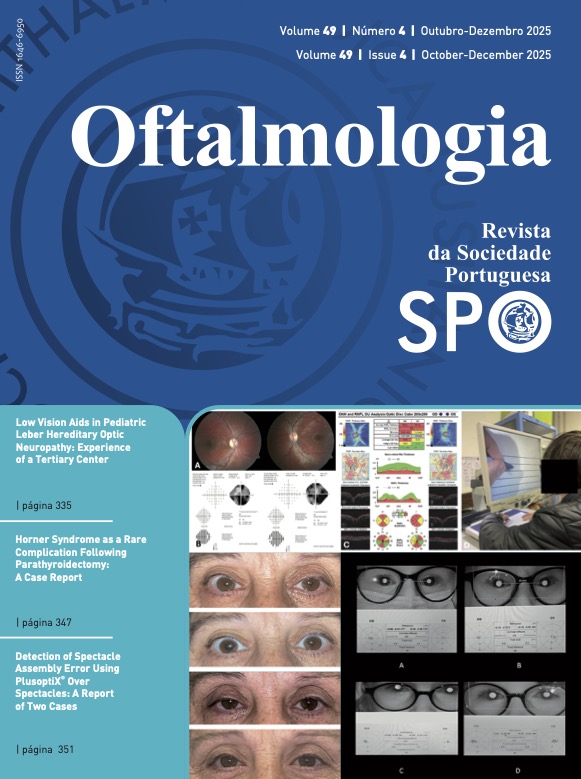
Low Vision Aids in Pediatric Leber Hereditary Optic Neuropathy: Experience of a Tertiary Center
DOI:
https://doi.org/10.48560/rspo.38329Keywords:
Child, Optic Atrophy, Hereditary, Leber/therapy, Optical Devices, Visual AcuityAbstract
INTRODUCTION: Leber hereditary optic neuropathy (LHON) is the most common inherited mitochondrial disorder. It typically affects young males, but its onset in childhood is rare. Treatment is limited and include the use of idebenone. Furthermore, to improve visual performance and academic and social adaptation, low vision aids are crucial. We report our experience with pediatric LHON and the low vision aids we recommend for these patients.METHODS: Retrospective study of a Portuguese pediatric LHON cohort with confirmed pathogenic mitochondrial mutation, followed in our Pediatric Ophthalmology and Low Vision Center.
RESULTS: We enrolled 3 patients, all male, of 8, 14 and 15 years old. Vision loss and diagnosis occurred at 5, 10 and 14 years old, respectively. The variants m.1309AT>C (patient 1, Leber plus) and m.3460G>A (patients 2 and 3, Leber) were present. Best-corrected visual acuity (BCVA) was: 20/20 in the right eye (OD), 20/30 in the left eye (OS), with subjective ecocentral and peripheral visual field loss (patient 1), 20/100 OD, 20/200 OS, with ecocentral and diffuse defects on perimetry (patient 2) and 20/400 in both eyes (OU) with severe visual field constriction and central islands of vision sparing (patient 3). Neuroimaging, multimodal ophthalmic imaging and blood analysis were performed before definitive diagnosis. Since diagnosis, all the children started idebenone and were evaluated by the low vision multidisciplinary team (ophthalmologists, pediatricians, physiatrists, geneticists, psychologists, orthoptic technicians, social workers and special education teachers) along with the low vision team to promote concomitant visual rehabilitation. Patient 1 only requires individual school support. Patient 2 uses a monocular, focusable, hand-held Keplerian telescope for far with improvement of the BCVA to 20/20 OS and video magnifier systems with good adaptation and reading speed improvement. Patient 3 also benefits from video magnifiers and a hand-held magnifier for near, with improved visual tasks.
CONCLUSION: Along with medical treatment and follow-up, the approach to pediatric LHON must include low vision rehabilitation. As shown here, the availability of a wide range of aids for near and far vision greatly improves visual performance and allows for greater participation in school and social activities, facilitating the healthy development of these children.
Downloads
References
Sundaramurthy S, SelvaKumar A, Ching J, Dharani V, Sarangapani S, Yu-Wai-Man P. Leber hereditary optic neuropathy: new insights and old challenges. Graefes Arch Clin Exp Ophthalmol. 2021;259:2461-72. doi: 10.1007/s00417-020-04993-1.
Liutkeviciene R, Sidaratie A, Kuliaviene L, Glebauskiene B, Jurkute N, Aluzaitie-Baranauskiene L, et al. A Typical Case Presentation with Spontaneous Visual Recovery in Patient Diagnosed with Leber Hereditary Optic Neuropathy due to Rare Point Mutation in MT-ND4 Gene (m.11253T>C) and Literature Review. Medicina. 2021;57:202. doi: 10.3390/medicina57030202.
Fraser JA, Biousse V, Newman NJ. The neuro-ophthalmology of mitochondrial disease. Surv Ophthalmol. 2010;55:299-334. doi: 10.1016/j.survophthal.2009.10.002.
Mascialino B, Leinonen M, Meier T. Meta-analysis of the prevalence of Leber hereditary optic neuropathy mtDNA mutations in Europe. Eur J Ophthalmol. 2012;22:461-5. doi: 10.5301/ejo.5000055.
Meyerson C, Van Stavern G, McClelland C. Leber hereditary optic neuropathy: current perspectives. Clin Ophthalmol. 2015 Jun 26;9:1165-76. doi: 10.2147/OPTH.562021.
Hudson G, Yu-Wai-Man P, Chinnery PF. Leber hereditary optic neuropathy. Expert Opin Med Diagn. 2008;2:789-99. doi: 10.1517/17530059.2.7.789.
Newman NJ. Hereditary optic neuropathies: from the mitochondria to the optic nerve. Am J Ophthalmol. 2005;140:517-23. doi: 10.1016/j.ajo.2005.03.017.
Kavitha V, Heralgi MM, Parkar M, Harooppoa S. Quality of life in children with low vision following use of low vision aids. Taiwan J Ophthalmol. 2019;10:203-7. doi: 10.4103/ijo.ijo_94_18.
Gopalakrishnan S, Bhaskaran G, Jayasankar O, Selvakumar A, Raman R. Changes in visual acuity using low vision devices in patients with Leber hereditary optic neuropathy: A retrospective study. Indian J Ophthalmol. 2023;71:402-7. doi: 10.4103/ijo.JIO_1130_22.
Barker L, Thomas R, Rubin G, Dahlmann-Noor A. Optical reading aids for children and young people with low vision. Cochrane Database Syst Rev. 2015;2015:CD010987. doi: 10.1002/14651858.CD010987.pub2.
Virgili G, Acosta R, Bentley SA, Giacomelli G, Allcock C, Evans JR. Reading aids for adults with low vision. Cochrane Database Syst Rev. 2018;4:CD003303. doi: 10.1002/14651858.CD003303.pub4.
Perrault MA, Lauer G, Voss S, Seitz B, Kasmann-Kellner B. Visual Impairment and Low Vision Aids-A Comparison between Children and Adults. J Pers Med. 2023;13:1608. doi: 10.3390/jpm13111608.
Kirkman MA, Korsten A, Leonhardt M, Dimitriadis K, De Coo IF, Klopstock T, et al. Quality of life in patients with leber hereditary optic neuropathy. Invest Ophthalmol Vis Sci. 2009;50:3112-5. doi: 10.1167/iovs.08-3166.
Stelmack JA, Tang XC, Reda DJ, et al. Outcomes of the Veterans Affairs Low Vision Intervention Trial (LOVIT). Arch Ophthalmol. 2008;126:608-17. doi:10.1001/archopht.126.5.608
Rudanko SL. Visual rehabilitation of persons with Leber’s hereditary optic neuropathy. J Vis Impair Blind. 1995;89:153 6.
Becker SL, Nowakowski RW. Leber optic atrophy low vision case report. Am J Optom Physiol Opt. 1988;65:209 11.
Zaky AG, El Bayoumi B, Elghoubashy ES, Sarhan AE, Zaky MA. Eccentric viewing training for low vision rehabilitation in patients with central scotoma. Menoufia Med J. 2020;33:1186.
Yu-Wai-Man P, Griffiths PG, Hudson G, Chinnery PF. Inherited mitochondrial optic neuropathies. J Med Genet. 2009;46:145-58. doi: 10.1136/jmg.2007.054270.
Emperador S, Vidal M, Hernández-Ainsa C, Ruiz-Ruiz C, Woods D, Morales-Becerra A, et al. The Decrease in Mitochondrial DNA Mutation Load Parallels Visual Recovery in a Leber Hereditary Optic Neuropathy Patient. Front Neurosci. 2018;12:61. doi: 10.3389/fnins.2018.00061.
Barboni P, Savini G, Valentino ML, Montagna P, Cortelli P, De Negri AM, et al. Retinal nerve fiber layer evaluation by optical coherence tomography in Leber’s hereditary optic neuropathy. Ophthalmology. 2005;112:120-6. doi: 10.1016/j.ophtha.2004.06.034.
Barboni P, Savini G, Valentino ML, La Morgia C, Bellusci C, De Negri AM, et al. Leber’s hereditary optic neuropathy with childhood onset. Invest Ophthalmol Vis Sci. 2006;47:5303-9. doi: 10.1167/iovs.06-0520.
Ramos Cdo V, Bellusci C, Savini G, Carbonelli M, Berezovsky A, Tamaki C, et al. Association of optic disc size with development and prognosis of Leber’s hereditary optic neuropathy. Invest Ophthalmol Vis Sci. 2009;50:1666-74. doi: 10.1167/iovs.08-2695.
Carelli V, La Morgia C, Valentino ML, Rizzo G, Carbonelli M, De Negri AM, et al. Idebenone treatment in Leber’s hereditary optic neuropathy. Brain. 2011;134:e188. doi: 10.1093/brain/awr180.
Klopstock T, Yu-Wai-Man P, Dimitriadis K, Rouleau J, Heck S, Bailie M, et al. A randomized placebo-controlled trial of idebenone in Leber’s hereditary optic neuropathy. Brain. 2011;134:2677-86. doi: 10.1093/brain/awr170.
de Castro CT, Berezovsky A, de Castro DD, Salomão SR. Reabilitação visual em pacientes com reínose pigmentária. Arq Bras Ofralmol. 2006;69:687-90. doi: 10.1590/s0004-2749200600500013.
Moya STF, Oliveira A, Fernandes L. Retinitis pigmentosa and low vision: functional use of near low vision aids and correlation with visual functions. Rev Bras Ofralmol. 2003;62:679-88.
Downloads
Published
How to Cite
Issue
Section
License
Copyright (c) 2025 Revista Sociedade Portuguesa de Oftalmologia

This work is licensed under a Creative Commons Attribution-NonCommercial 4.0 International License.
Do not forget to download the Authorship responsibility statement/Authorization for Publication and Conflict of Interest.
The article can only be submitted with these two documents.
To obtain the Authorship responsibility statement/Authorization for Publication file, click here.
To obtain the Conflict of Interest file, click here