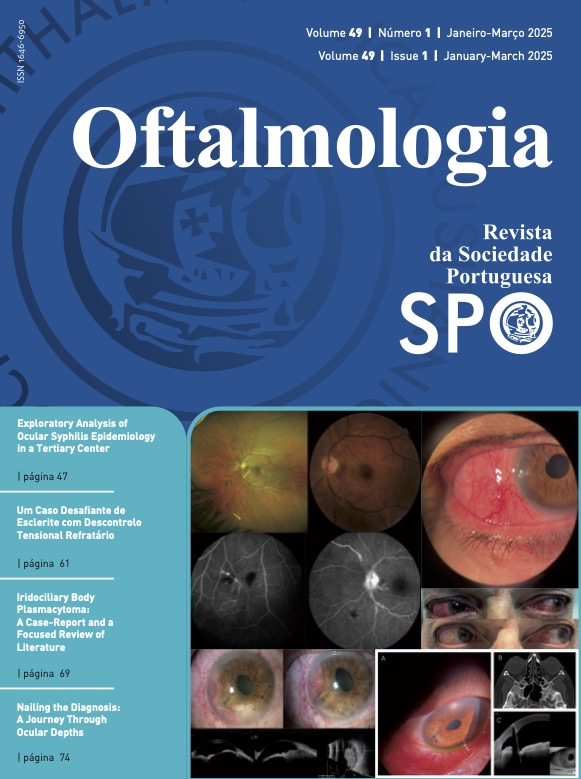
Exploratory Analysis of Ocular Syphilis Epidemiology in a Tertiary Center
DOI:
https://doi.org/10.48560/rspo.33225Keywords:
Eye Infections, Bacterial/diagnosis, Eye Infections, Bacterial/epidemiology, Syphilis/diagnosis, Syphilis/epidemiology, UveitisAbstract
INTRODUCTION: Syphilis incidence has been increasing and, consequently, so has ocular syphilis (OS), an uncommon cause of ocular inflammation with many disease phenotypes. We aimed to estimate the number of OS cases diagnosed in a tertiary centre in Portugal, to correlate with the increase in syphilis diagnosis and characterize the OS population.METHODS: We conducted a retrospective, observational, single-center study that included patients with OS, from 2015 to 2023 at Centro Hospitalar e Universitário de Coimbra (CHUC). Demographic data were collected and a complete ophthalmological examination was performed with multimodal imaging acquisition. Data on syphilis incidence from the European Center for Disease Prevention and Control (ECDC) and Portuguese National Healthcare Service (NHS), correlated with OS data.
RESULTS: In total, 49 patients with OS were observed. The mean age of 54.29±14.84 years, 36 (73.47%) were male and 16 (44.44%) were men who have sex with men. Considering syphilis diagnosis at our institution, the proportion of ocular syphilis in these patients per year ranged from 0% to 7.14%. Twelve patients (24.49%) were co-infected with HIV. Forty-five patients (91.84%) complained of decreased visual acuity. Ocular pain, hyperemia, photophobia, photopsias and floaters were also reported. Nineteen patients (38.78%) had systemic findings (mostly skin rash). In 33 cases (67.35%), the presentation was bilateral and 24 (48.98%) presented with anterior segment involvement. Forty-two patients (85.71%) had posterior segment involvement and the most common phenotypical presentation was posterior placoid chorioretinitis (21%-50.0%). Nineteen patients (38.78%) had optic nerve involvement. All patients were admitted and underwent 2-week treatment with endovenous penicillin. Visual acuity improved from logMAR 0.71 to logMAR 0.25 (p<0.001). Syphilis incidence gradually increased in the years considered and a peak of disease diagnoses was registered in 2022, after the COVID-19 pandemic.
CONCLUSION: Syphilis is a public health challenge. OS is a heterogeneous disease with a wide range of presentations. The incidence is on the rise and must be considered in every patient with uveitis or optic neuritis.
Downloads
References
Amerson EH, Castillo Valladares HB, Leslie KS. Resurgence of Syphilis in the US-USPSTF Reaffirms Screening Guidelines. JAMA Dermatol. 2022;158:1241-3. doi: 10.1001/jamadermatol.2022.3499.
European Centre for Disease Prevention and Control (ECDC). Syphilis Annual Epidemiological Report for 2019. SURVEILLANCE REPORT. [cited 2023 May]. Available from: https://www.ecdc.europa.eu/sites/default/files/documents/syphilis-annual-epidemiological-report-2019.pdf.
European Centre for Disease Prevention and Control (ECDC). Surveillance Atlas of Infectious Diseases. [cited 2023 May]. Available from: https://atlas.ecdc.europa.eu/public/index.aspx.
Sentís A, Prats-Uribe A, López-Corbeto E, Montoro-Fernandez M, Nomah DK, de Olalla PG, et al. The impact of the COVID-19 pandemic on Sexually Transmitted Infections surveillance data: incidence drop or artefact? BMC Public Health. 2021;21:1637. doi: 10.1186/s12889-021-11630-x.
Instituto Nacional de Estatística (INE). Estatísticas da Saúde 2018. [cited 2023 May]. Available from: https://www.ine.pt/xportal/xmain?xpid=INE&xpgid=ine_publicacoes&PUBLICACOEStipo=ea&PUBLICACOEScoleccao=107773&selTab=tab0&xlang=pt.
Serviço Nacional de Saúde. Doenças de Declaração Obrigatória. Transparência [cited 2023 May]. Available from: https://transparencia.sns.gov.pt/explore/?sort=title&q=doen%C3%A7as+de+declara%C3%A7%C3%A3o+obrigat%C3%B3ria.
Furtado JM, Arantes TE, Nascimento H, Vasconcelos-Santos DV, Nogueira N, de Pinho Queiroz R, et al. Clinical Manifestations and Ophthalmic Outcomes of Ocular Syphilis at a Time of Re-Emergence of the Systemic Infection. Sci Rep. 2018;8:12071. doi: 10.1038/s41598-018-30559-7. Erratum in: Sci Rep. 2018;8:15902. doi: 10.1038/s41598-018-34170-8.
Tyagi M, Kaza H, Pathengay A, Agrawal H, Behera S, Lodha D, et al. Clinical manifestations and outcomes of ocular syphilis in Asian Indian population: Analysis of cases presenting to a tertiary referral center. Indian J Ophthalmol. 2020;68:1881-6. doi: 10.4103/ijo.IJO_809_20.
Pichi F, Neri P. Multimodal imaging patterns of posterior syphilitic uveitis: a review of the literature, laboratory evaluation and treatment. Int Ophthalmol. 2020;40:1319-29. doi: 10.1007/s10792-020-01285-9.
Kabanovski A, Donaldson L, Jeeva-Patel T, Margolin EA. Optic Disc Edema in Syphilis. J Neuroophthalmol. 2022;42:e173-80. doi: 10.1097/WNO.0000000000001302.
Jabs DA, Nussenblatt RB, Rosenbaum JT; Standardization of Uveitis Nomenclature (SUN) Working Group. Standardization of uveitis nomenclature for reporting clinical data. Results of the First International Workshop. Am J Ophthalmol. 2005;140:509-16. doi: 10.1016/j.ajo.2005.03.057.
Ortiz DA, Shukla MR, Loeffelholz MJ. The Traditional or Reverse Algorithm for Diagnosis of Syphilis: Pros and Cons. Clin Infect Dis. 2020;71:S43-S51. doi: 10.1093/cid/ciaa307.
Wells J, Wood C, Sukthankar A, Jones NP. Ocular syphilis: the re-establishment of an old disease. Eye. 2018;32:99-103. doi: 10.1038/eye.2017.155.
Vadboncoeur J, Labbé AC, Fortin C, Serhir B, Rabia Y, Najem K, et al. Ocular syphilis: case series (2000-2015) from 2 tertiary care centres in Montreal, Canada. Can J Ophthalmol. 2020;55:30-7. doi: 10.1016/j.jcjo.2019.05.009.
Jay CA. Treatment of neurosyphilis. Curr Treat Options Neurol. 2006;8:185-92. doi: 10.1007/s11940-006-0009-7.
Browning DJ. Posterior segment manifestations of active ocular syphilis, their response to a neurosyphilis regimen of penicillin therapy, and the influence of human immunodeficiency virus status on response. Ophthalmology. 2000;107:2015-23. doi: 10.1016/s0161-6420(00)00457-7.
Workowski KA, Bolan GA; Centers for Disease Control and Prevention. Sexually transmitted diseases treatment guidelines, 2015. MMWR Recomm Rep. 2015;64:1-137. Erratum in: MMWR Recomm Rep. 2015;64:924.
Workowski KA. Centers for Disease Control and Prevention Sexually Transmitted Diseases Treatment Guidelines. Clin Infect Dis. 2015;61:S759-62. doi: 10.1093/cid/civ771.
Moradi A, Salek S, Daniel E, Gangaputra S, Ostheimer TA, Burkholder BM, et al. Clinical features and incidence rates of ocular complications in patients with ocular syphilis. Am J Ophthalmol. 2015;159:334-43.e1. doi: 10.1016/j.ajo.2014.10.030.
Balaskas K, Sergentanis TN, Giulieri S, Guex-Crosier Y. Analysis of significant factors influencing visual acuity in ocular syphilis. Br J Ophthalmol. 2011;95:1568-72. doi: 10.1136/bjo.2010.194498.
Northey LC, Skalicky SE, Gurbaxani A, McCluskey PJ. Syphilitic uveitis and optic neuritis in Sydney, Australia. Br J Ophthalmol. 2015;99:1215-9. doi: 10.1136/bjophthalmol-2014-306168.
Hoogewoud F, Frumholtz L, Loubet P, Charlier C, Blanche P, Lebeaux D, et al. Prognostic Factors in Syphilitic Uveitis. Ophthalmology. 2017;124:1808-16. doi: 10.1016/j.ophtha.2017.06.003.
Reekie I, Reddy Y. Use of Lumbar Punctures in the Management of Ocular Syphilis. Semin Ophthalmol. 2018;33:271-4. doi: 10.1080/08820538.2016.1228986.
Durnian JM, Naylor G, Saeed AM. Ocular syphilis: the return of an old acquaintance. Eye. 2004;18:440-2. doi: 10.1038/sj.eye.6700687.
Downloads
Published
How to Cite
Issue
Section
License
Copyright (c) 2024 Revista Sociedade Portuguesa de Oftalmologia

This work is licensed under a Creative Commons Attribution-NonCommercial 4.0 International License.
Do not forget to download the Authorship responsibility statement/Authorization for Publication and Conflict of Interest.
The article can only be submitted with these two documents.
To obtain the Authorship responsibility statement/Authorization for Publication file, click here.
To obtain the Conflict of Interest file, click here