
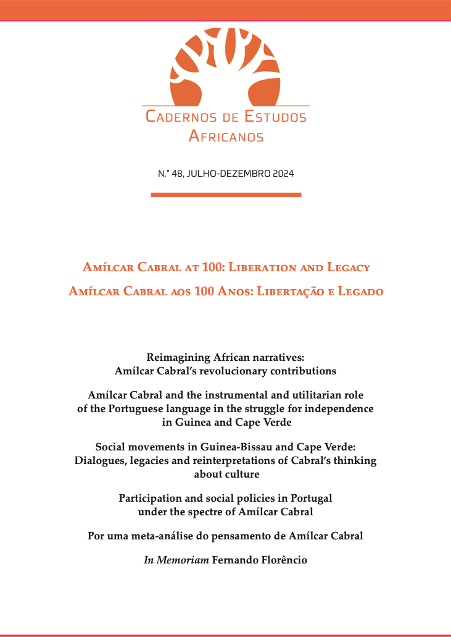
Social Movements in Guinea-Bissau and Cape Verde: Dialogues, legacies and reinterpretations of Cabral’s thinking about culture
DOI:
https://doi.org/10.15847/cea48.36737Resumo
Amílcar Cabral’s statement that “the struggle for liberation is, above all, an act of culture” has been a vital element in the construction of narratives, forms of organisation and mobilisation of social collectives for the transformation of Guinea-Bissau and Cape Verdean society. However, there is a notoriously odd absence and/or lack of formal endogenous Cabralist education, which has in the assumptions of its culture an important catalytic source of artivist production. This article, which is based on ethnographic and collaborative research carried out over the last decade in these two countries, sets out to address the challenge of rescuing Cabral’s ideals expressed through new forms of socio-cultural intervention within a framework of participatory and counter-colonial democracy. We will seek to understand how public processes of revindication and the creation of spaces for active and full citizenship have produced entities capable of revolutionising both societies.
Downloads
Publicado
Edição
Secção
Licença
Direitos de Autor (c) 2025 Cadernos de Estudos Africanos

Este trabalho encontra-se publicado com a Licença Internacional Creative Commons Atribuição-NãoComercial-CompartilhaIgual 4.0.
Autorizo a publicação do artigo/recensão submetido do qual sou autor.
Declaro ainda que o presente artigo é original, que não foi objecto de qualquer tipo de publicação, e cedo em exclusivo os direitos de publicação à revista Cadernos de Estudos Africanos. A reprodução do artigo, no todo ou em parte, noutras publicações ou noutros suportes depende de autorização prévia da editora Centro de Estudos Internacionais do Iscte - Instituto Universitário de Lisboa.