
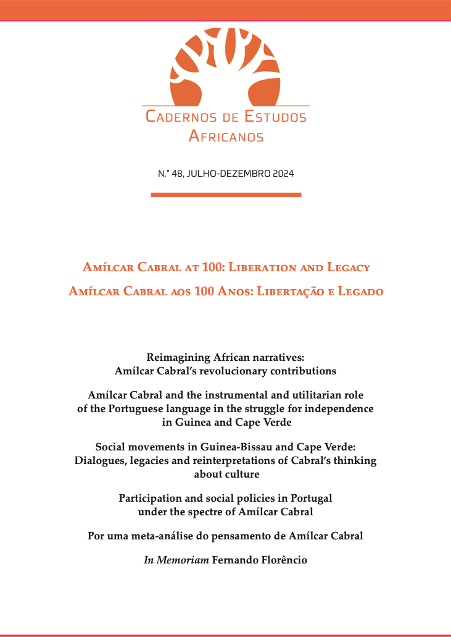
Social movements in Guinea-Bissau and Cape Verde: Dialogues, legacies, and reinterpretations of Cabral’s thoughts on culture
DOI:
https://doi.org/10.15847/cea48.36737Abstract
Amílcar Cabral’s statement that “the liberation struggle is, first and foremost, an act of culture” has been a structuring element in the construction of narratives, forms of organization and mobilization of social collectives for the transformation of Bissau-Guinean and Cape Verdean societies. However, there is a notorious absence and/or lack of formal endogenous processes of Cabralist education that have in the assumptions of culture an important catalyzing source of artivist production. This article, which is based on ethnographic and collaborative research conducted over the last decade in these two countries, aims to rescue Cabralist ideals within new forms of expressive socio-cultural intervention within a framework of participatory and counter-colonial democracy. It will seek to understand how the processes of claiming and recreating spaces for active and full citizenship have constituted entities capable of revolutionizing both societies.
Downloads
Published
Issue
Section
License
Copyright (c) 2025 Cadernos de Estudos Africanos

This work is licensed under a Creative Commons Attribution-NonCommercial-ShareAlike 4.0 International License.
I authorize the publication of the submitted article/review of which I am the author.
I also declare that this article is original, that it has not been published in any other way, and that I exclusively assign the publication rights to the journal Cadernos de Estudos Africanos. Reproduction of the article, in whole or in part, in other publications or on other media is subject to the prior authorization of the publisher Centro de Estudos Internacionais do Iscte - Instituto Universitário de Lisboa.