
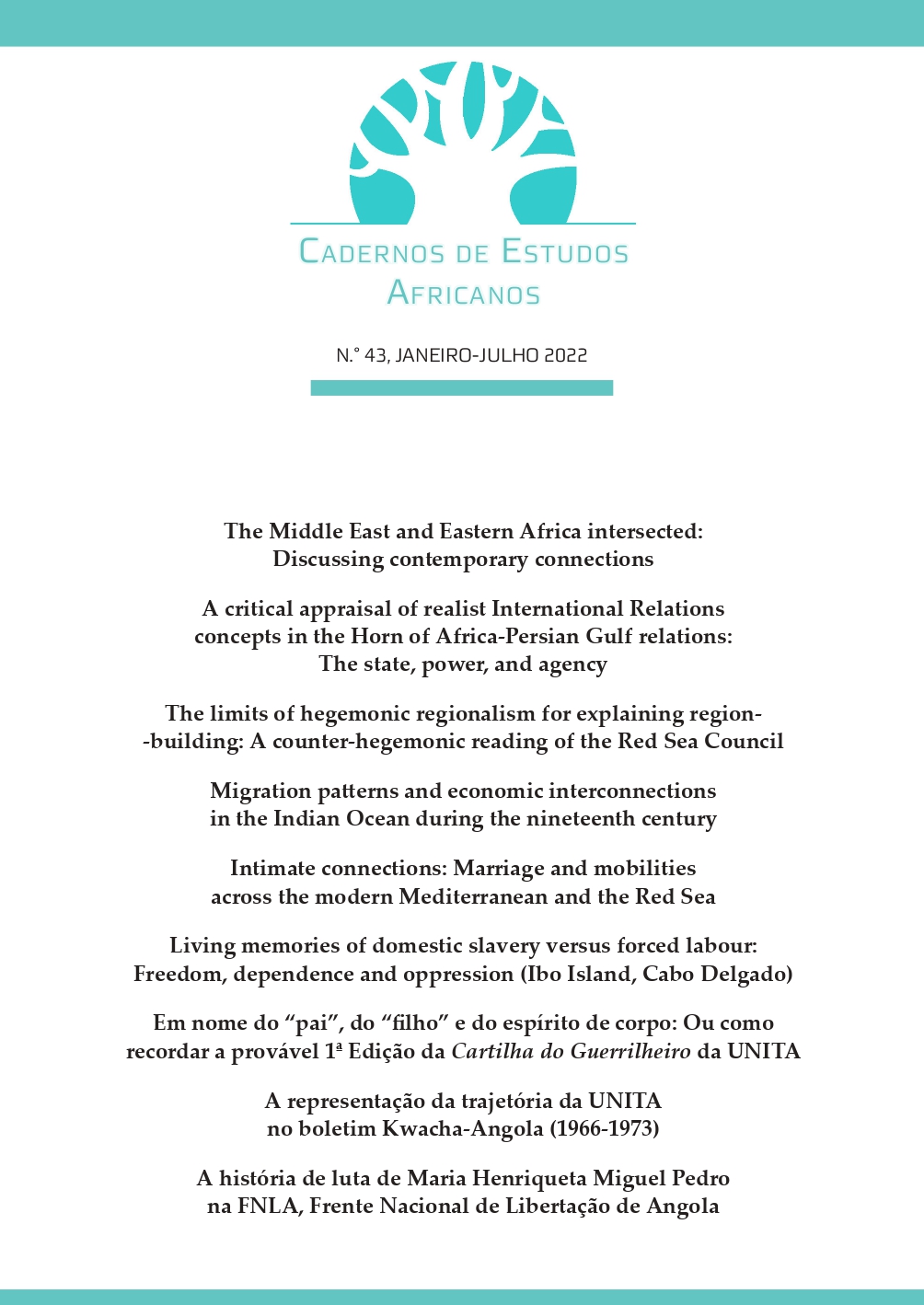
Migration Patterns and Economic Interconnections in the Indian Ocean during the Nineteenth Century
DOI:
https://doi.org/10.4000/cea.6970Abstract
The Indian Ocean acted as a central hub, facilitating relationships between the SouthCentral Asian littorals, the main coasts of Oman, and the Swahili coasts of East Africa from Mogadishu to Kilwa. The focus of this paper is to reevaluate the migration patterns that shaped East African-Swahili societies during the nineteenth century. However, the available literature on this topic has been limited. Specifically, the Baloch in East Africa during the 1800s have often been viewed as a monolithic presence, associated only with defense military squadrons. Nevertheless, it is crucial to recognize the roles played by Asian communities in East Africa, which challenges the conventional belief that Asian groups only arrived in East Africa as military squads between the eighteenth and nineteenth centuries.
Additional Files
Published
Issue
Section
License

This work is licensed under a Creative Commons Attribution-NonCommercial-ShareAlike 4.0 International License.
I authorize the publication of the submitted article/review of which I am the author.
I also declare that this article is original, that it has not been published in any other way, and that I exclusively assign the publication rights to the journal Cadernos de Estudos Africanos. Reproduction of the article, in whole or in part, in other publications or on other media is subject to the prior authorization of the publisher Centro de Estudos Internacionais do Iscte - Instituto Universitário de Lisboa.