
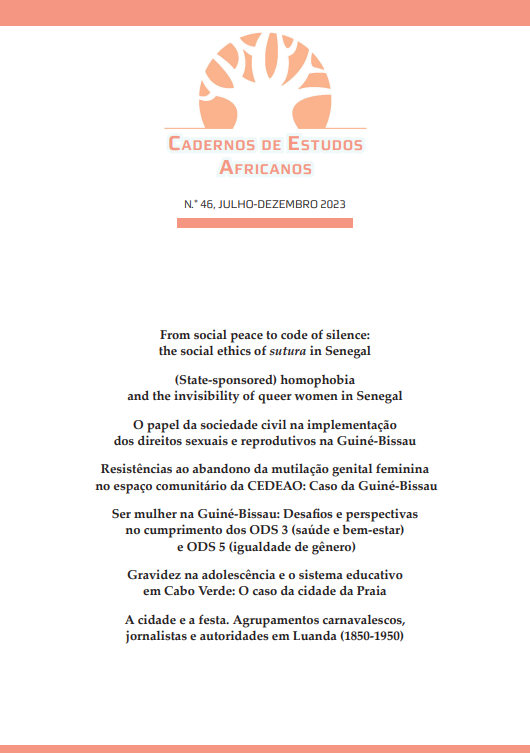
The city and the party. Carnival groups, journalists, and authorities in Luanda (1850-1950)
DOI:
https://doi.org/10.15847/cea46.35419Abstract
Through newspapers published in Luanda, this paper presents an overview of the history of the carnival groups, and their relations with journalists and authorities, between the mid-nineteenth century and the mid-twentieth century. It defends the existence of contradictory relations derived from paternalistic practices, which involved, from the authorities’ point of view, perspectives of tolerance, control, repression, and incentive to the carnival groups. Such perspectives were constructed not only from the events of colonial domination but also from the different and changeable meanings attributed to the carnival groups and their corteges, both by journalists and authorities and by the marginalized segments that participated in them. It is intended to demonstrate that, through the history of carnival groups, it is possible to perceive fundamental dynamics of the colonial presence, and its transformations over time.
Downloads
Published
Issue
Section
License
Copyright (c) 2025 Cadernos de Estudos Africanos

This work is licensed under a Creative Commons Attribution-NonCommercial-ShareAlike 4.0 International License.
I authorize the publication of the submitted article/review of which I am the author.
I also declare that this article is original, that it has not been published in any other way, and that I exclusively assign the publication rights to the journal Cadernos de Estudos Africanos. Reproduction of the article, in whole or in part, in other publications or on other media is subject to the prior authorization of the publisher Centro de Estudos Internacionais do Iscte - Instituto Universitário de Lisboa.