
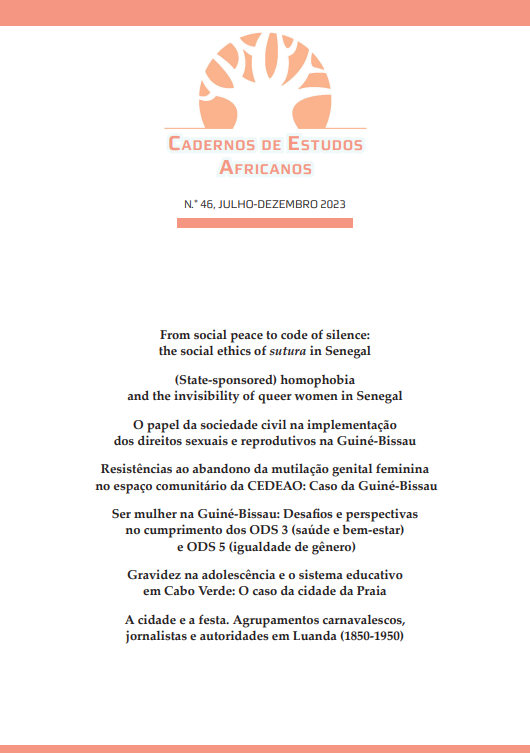
Resistance to the abandonment of female genital mutilation in the ECOWAS community space: The case of Guinea-Bissau
DOI:
https://doi.org/10.15847/cea46.35778Abstract
Female Genital Mutilation is a widespread practice in the West African region. Efforts to eliminate this practice have encountered various forms of resistance. In Guinea-Bissau, the case study, more than a decade after the practice was criminalized, the number of cases has risen, and the consensus on abandoning the practice appears to be a long way off. This article aims to understand the reasons behind the resistance to discontinuing FGM in Guinea-Bissau, starting from the sub-regional context. In Guinea-Bissau, it has been observed that community leaders are the primary agents of resistance, while civil society organizations take the lead in the fight against FGM. Additionally, the fragility of the judicial system and the high illiteracy rate pose significant challenges to the eradication of FGM. To address this issue, reforms in the education and judicial systems, along with a broad national discussion on FGM, should be considered crucial for eradication efforts.
Downloads
Published
Issue
Section
License
Copyright (c) 2025 Cadernos de Estudos Africanos

This work is licensed under a Creative Commons Attribution-NonCommercial-ShareAlike 4.0 International License.
I authorize the publication of the submitted article/review of which I am the author.
I also declare that this article is original, that it has not been published in any other way, and that I exclusively assign the publication rights to the journal Cadernos de Estudos Africanos. Reproduction of the article, in whole or in part, in other publications or on other media is subject to the prior authorization of the publisher Centro de Estudos Internacionais do Iscte - Instituto Universitário de Lisboa.