
Introduction
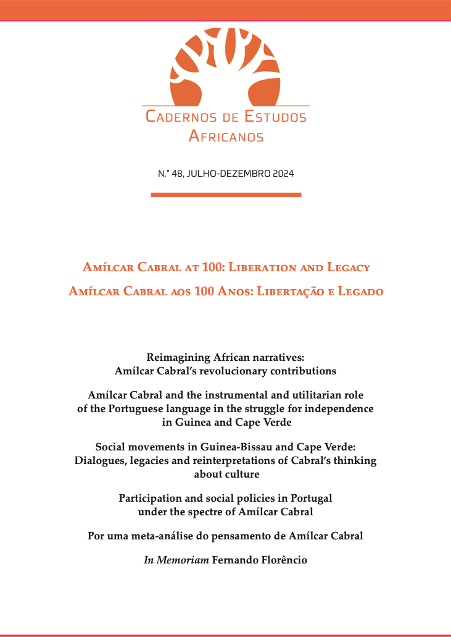
Amílcar Cabral: Revolutionary legacy and contemporary resonance
DOI:
https://doi.org/10.15847/cea48.43780Abstract
The centenary of Amílcar Cabral presents an essential opportunity to reflect on one of the most influential political and intellectual figures in Africa’s anti-colonial struggles. His life and work symbolise the complex transition from colonial domination to independent statehood, but also from externally imposed models of development to an endogenous praxis of liberation, rooted in culture, history, and people’s agency.
The global momentum for decolonisation accelerated after the Second World War. Across Africa and Asia, demands for sovereignty intensified, fuelled by growing nationalist movements and supported by shifts in the international system. The creation of the United Nations Special Committee on Decolonisation in 1961 formalised this new global agenda. Yet, by that time, several African nations had already gained independence, and many more would follow throughout the 1960s.
Portugal, however, stood apart. The authoritarian Estado Novo regime linked its survival to its colonial empire, insisting that Angola, Mozambique, Guinea-Bissau, Cabo Verde, São Tomé and Príncipe, East Timor, and the Estado Português da Índia (Goa, Daman, Diu, Dadrá, and Nagar Haveli) were not colonies but “overseas provinces”. This semantic camouflage did little to alter the colonial realities of exploitation, cultural subjugation, and racial hierarchy. As other European empires negotiated transitions to independence, Portugal clung to an anachronistic imperialism, forcing anti-colonial movements to choose between submission and armed struggle.
In this context, Amílcar Cabral emerged as a central figure. Born in Bafatá, Guinea-Bissau, to Cabo Verdean parents, Cabral’s life embodied the intertwined destinies of Guinea-Bissau and Cabo Verde – a connection he would later enshrine in the program of the African Party for the Independence of Guinea and Cabo Verde (PAIGC). Cabral’s formative years in Lisbon during the 1940s and early 1950s were decisive. There, he engaged with a wide circle of African students and intellectuals, participating in the Casa dos Estudantes do Império, where anti-colonial ideas circulated alongside cultural and literary projects.
Among his interlocutors, the Angolan Mário Pinto de Andrade stood out as his main intellectual alter ego. Their friendship was more than personal; it was a sustained dialogue on the nature of colonial oppression, the role of culture in resistance, and the theoretical underpinnings of liberation. Mário de Andrade would later become Cabral’s biographer, ensuring his legacy was both chronicled and critically examined. Other members of this network, such as the also Angolan Agostinho Neto, the Mozambican Marcelino dos Santos, and Francisco José Tenreiro, originally from São Tomé, also played crucial roles in the political and cultural emancipation of Lusophone Africa. Yet Cabral’s contribution was distinctive: he developed a theory of liberation that transcended nationalist slogans, articulating the decolonisation of the mind, the valorisation of indigenous culture, and the strategic use of knowledge for social transformation.
Cabral combined his training as an agronomist with political leadership, uniting scientific analysis and revolutionary praxis. He understood that liberation could not be reduced to military victory or political independence; it required a redefinition of development rooted in dignity, equity, and cultural affirmation. His assassination in 1973, just months before Guinea-Bissau’s unilateral declaration of independence, deprived the continent of one of its most visionary leaders. Nevertheless, his intellectual and political contributions continue to resonate globally.
Downloads
Published
Issue
Section
License
Copyright (c) 2025 Cadernos de Estudos Africanos

This work is licensed under a Creative Commons Attribution-NonCommercial-ShareAlike 4.0 International License.
I authorize the publication of the submitted article/review of which I am the author.
I also declare that this article is original, that it has not been published in any other way, and that I exclusively assign the publication rights to the journal Cadernos de Estudos Africanos. Reproduction of the article, in whole or in part, in other publications or on other media is subject to the prior authorization of the publisher Centro de Estudos Internacionais do Iscte - Instituto Universitário de Lisboa.