
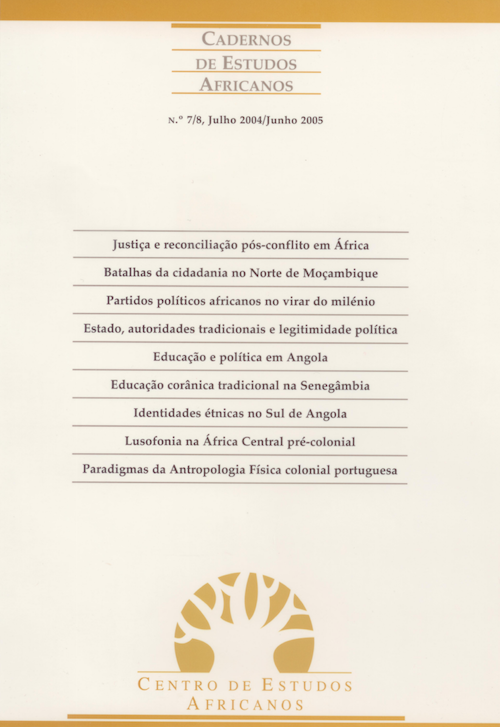
State, Traditional Authorities and Political Legitimacy: the parameters of a ‘marriage of convenience’ in Mandlakazi
DOI:
https://doi.org/10.4000/cea.1068Keywords:
Moçambique, autoridade tradicional, Estado, legitimidade, Mandlakazi, relação políticaAbstract
It is commonly accepted that the current process of «political modernization» in Mozambique has given increased visibility and importance to the problems concerningthe relationship between State and the Traditional Authorities.In face of the resilience of Traditional Authorities as mediation agencies between the present and the past, the State cannot afford to ignore their presence in the political landscape. The picture is rather complex: however predominantlybased on a modern political apparatus, the State also tries to include the Traditional Authorities under its umbrella, thus seeking to benefit both from «modern» and «traditional» political legitimization. Traditional Authorities, on the other hand, while fighting to keep control over their communities on their own terms, are nevertheless eager to capture some of the State resources, to increase their ability to maintainthe old ruling patterns, based on the existence of a clientelist network nurtured through the redistribution of wealth and positions of power.
References
J.-P. BAYART, 1989, L’État en Afrique: la politique du ventre, Paris: Fayard.
T. BIERSCHENK & J.-P. OLIVIER DE SARDAN, 1997, «Local Powers and a Distant State in Rural Central African Republic», in The Journal of Modern African Studies, n.º 35, 3.
DOI : 10.1017/S0022278X97002504
M. BRATTON & N. vander WALLE, 1997, Democratic Experiments in Africa: Regime Transitions in Comparative Perspective, Cambridge, Cambridge University.
Luís de BRITO, 1988, «Une Relecture nécessaire: la genèse du parti-État FRELIMO», in Politique Africaine, 29.
M. CAHEN, 1987, Mozambique: la Rèvolution Implosée, Paris, L’Harmattan.
N. CHAZAN, 1992, «Africa´s Democratic Challeng», in World Policy Journal, vol. IX, n.º 2.
E. C. DIAS, 2001, «Estado, Política e Dignatários Político-religiosos: O caso senegâmbiano», in Cadernos de Estudos Africanos, 1, Lisbo, CEA-ISCTE.
B. EGERO, 1992, Moçambique: os primeiros dez anos de construção da democracia, Maputo, AHM.
J. F. FELICIANO, 1989, Antropologia Económicados Thongado Sul de Moçambique, Lisboa, Dissertação de Doutoramento em Antropologia Económica, apresentada à Universidade Técnica de Lisboa, Instituto Superior de Ciências do Trabalho e da Empresa.
G. GEFFRAY, 1990, La cause des armes au Mozambique. Anthropologie d’une guerre civil, Paris, Credu-Karthala.
J. HANLON, 1984, Mozambique: The Revolution Under Fire, London, Zed.
J. HARBESON, 1994, «Civil society and Political Renaisance in Africa», in N. CHAZAN, J. HARBESON & D. ROTHSCHILD (eds.), Civil Society and the State in Africa, Boulder, Lynne Rienner.
H. HOWE & M. OTTAWAY, 1987, «State Power Consolidation in Mozambique», in E. J. KELLER & D. ROTHSCHILD (eds.), Afro-Marxism Regimes: Ideology and Public Policy, Boulder, Colorado, Lynne Rienner.
A. H. JUNOD, 1944, Usos e Costumesdos Bantu, Lourenço Marques, Imprensa Nacional de Moçambique.
M. MANDANI, 1996, Citizen and Subject. Contemporary Africa and the legacy of late colonialism, London, James Curry.
W. MINTER, 1994, Os Contras do Apartheid – As Raízes da Guerra em Angola e Moçambique, Maputo, AHM.
D. RAY, 1998, «Chief-State relations in Ghana – Divided sovereignty and legitimacy», in E. Adriaan van ROUVEROY VAN VIEUWAAL & Werner ZIPS (eds.), Sovereignty, Legitimacy, and Power in West African Societies – Perspectives from Legal Anthropology, Hamburg, Lit Verlag.
E. Adriaan van ROUVEROY VAN VIEUWAAL, 1996, «States and Chiefs: are chiefs mere puppets?», in Journal of Legal and Pluralism and Unofficial Law, 37-38.
E. Adriaan van ROUVEROY VAN VIEUWAAL, 1999, «Chieftaincy in Africa: Three Facets of a Hybrid Role», in E. Adriaan van ROUVEROY VAN VIEUWAAL & Rijk van DIJK (eds.), African Chieftaincy in a New Socio-Political Landscape, Leiden, Lit Verlag.
C.V. SCOTT, 1988, «Socialism and the ‘Soft State’ in Africa: an analysis of Angola and Mozambique», in Journal of Modern African Studies, 26, 1.
DOI : 10.1017/S0022278X00010302
Downloads
Published
Issue
Section
License
Copyright (c) 2016 Cadernos de Estudos Africanos

This work is licensed under a Creative Commons Attribution-NonCommercial-ShareAlike 4.0 International License.
I authorize the publication of the submitted article/review of which I am the author.
I also declare that this article is original, that it has not been published in any other way, and that I exclusively assign the publication rights to the journal Cadernos de Estudos Africanos. Reproduction of the article, in whole or in part, in other publications or on other media is subject to the prior authorization of the publisher Centro de Estudos Internacionais do Iscte - Instituto Universitário de Lisboa.