
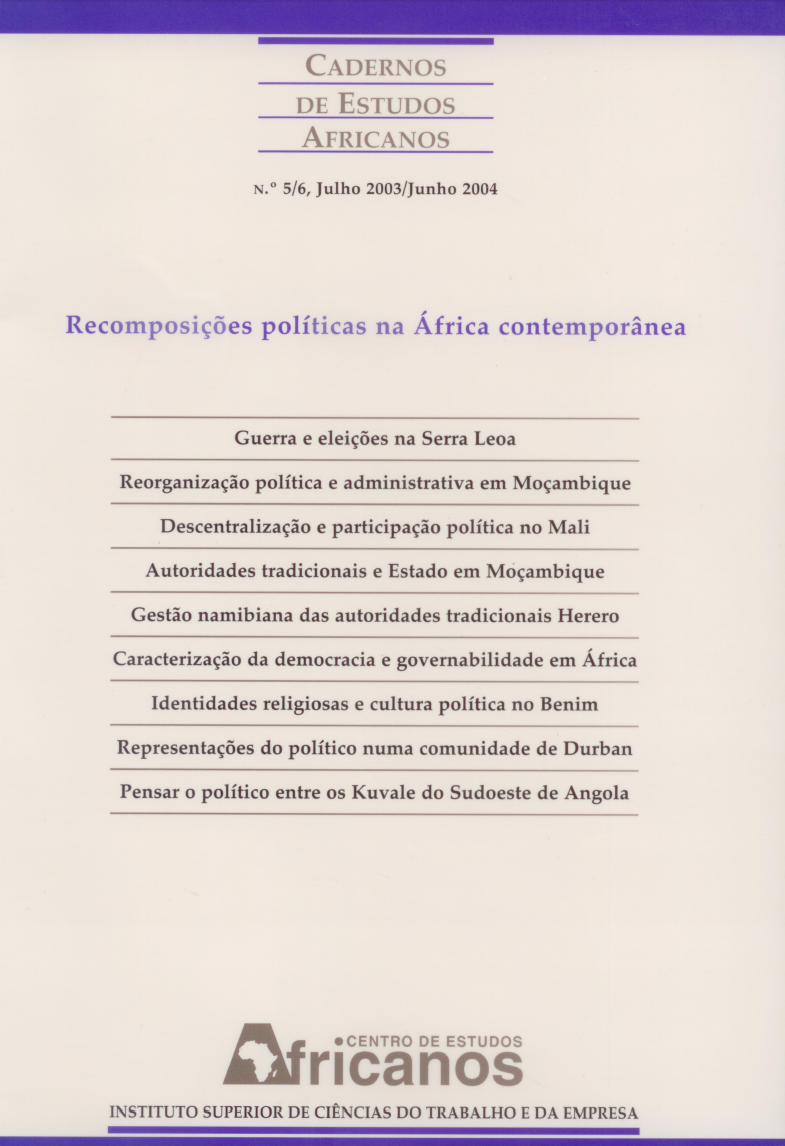
Traditional Authorities and the Mozambican State: the case of the Búzi district
DOI:
https://doi.org/10.4000/cea.1051Keywords:
Autoridade Tradicional, Estado, Reprodução social, Ndau, Búzio, Sofala, MoçambiqueAbstract
Based on a case study of the Búzi district in the province of Sofala, this article endeavours to sketch out a model of relationships ;between the Mozambican state and the traditional authorities vaNdau. The starting point of the argument is the consideration that the tradition al authorities vaNdau play their role of intermediaries between the state and the rural population by deriving the political legitimacy of their «hinge» position both from the traditional reproduction model of the vaNdau and from their statute as local «representatives» of the state. In this sense they establish a relationship between two models of social reproduction which are confronting each other, the traditional and the one adopted/favoured by the state a relationship which is at this stage precarious, complex, and ambivalent.
References
J. ALEXANDER (1994), «Terra e Autoridade Política no Pós-Guerra em Moçambique: O Caso da Província de Manica», in Arquivo (revista do Arquivo Histórico de Moçambique, Maputo), n.º 16, pp. 5-94.
J. ALEXANDER (1997), «The Local State in Post-War Mozambique: Political Practice and Ideas About Authority», in Africa: Journal of the International African Institute, 67 (1), pp. 1-25.
DOI : 10.2307/1161268
ARPAC (1993), «A Organização Política Ndau», in Recortes (revista da ARPAC, Maputo), n.º 5, pp. 25-30.
D. BEACH (1993), «As Origens de Moçambique e Zimbabwe: Paiva de Andrada, a Companhia de Moçambique e a Diplomacia Africana, 1881-91», in Arquivo, n.º 13. Franz BOAS (1920), «Abhandlungen und Vorträge. Der Seelenglaube der Vandau», in Zeitschrift für Ethnologie, vol. 52/53, n.º 1, pp. 1-5.
Franz BOAS (1922), «Das Verwandtschaftssystem der Vandau», in Zeitschrift für Ethnologie, vol. 54, pp. 41-51.
Franz BOAS (1923), «Ethnographische Bemerkungem über die Vandau», in Zeitschrift für Ethnologie, vol. 55, pp. 6-31.
J. A. G. M. BRANQUINHO (1966), «Prospecção das Forças Tradicionais. Manica e Sofala», Relatório do SCCI, Lourenço Marques.
E. Dora EARTHY (1930), «Sundry Notes on the Vandau of Sofala, P. E. A.», in Bantu Studies, vol. 4, n.º 2, pp. 95-107.
E. Dora EARTHY (1931), «Note on the “Totemism” of the Vandau», in Bantu Studies, vol. 5, pp. 77-79.
E. Dora EARTHY (1935), «A Vandau Ordeal of Olden Times», in Bantu Studies, vol. 9, n.º 2, pp. 159-161.
J. F. FELICIANO & V. H. NICOLAU [eds.] (1998), Memórias de Sofala. Etnografia e História das Identidades e da Violência entre os diferentes Poderes no Centro de Moçambique, séculos XVIII e XIX, textos de João Julião da Silva, Zacarias Herculano da Silva e Guilherme Ezequiel da Silva, Comissão Nacional para a Comemoração dos Descobrimentos Portugueses, Lisboa.
F. FLORÊNCIO (1994), Processos de Transformação Social no Universo Rural Moçambicano, Pós-Colonial. O Caso do Distrito do Búzi, dissertação de mestrado, ISCTE, Lisboa.
F. FLORÊNCIO (2002), «Identidade étnica e práticas políticas entre os vaNdau de Moçambique», Cadernos de Estudos Africanos, n.º 3, ISCTE, pp. 39-63.
C. GEFFRAY (1990), La Cause des Armes au Mozambique, Karthala, Paris.
M. HERSKOVITS (1923), «Some Property Concepts and Marriage Customs of the Vandau», in American Anthropologist, vol. 25, n.º 3, pp. 376-386.
DOI : 10.1525/aa.1923.25.3.02a00060
H. Ph. JUNOD (1934), «A Contribution to the Study of Ndau Demography, Totemism and History», in Bantu Studies, vol. 8, n.º 1, pp. 17-37.
H. Ph. JUNOD (1935), «Les Vandau de l’Afrique Orientale Portugaise», in Bulletin de la Société Neuchâteloise de Géographie, vol. 44, pp. 20-28.
H. Ph. JUNOD (1939), Os indígenas de Moçambique no século XVI e comêço do XVII segundo os antigos documentos portugueses da época dos Descobrimentos, Imprensa Nacional de Moçambique, Lourenço Marques.
R. J. KEITH (1987), «Christianity, Colonialism and the origins of Nationalism among the Ndau of Southern Rhodesia, 1890-1935», Tese de Doutoramento, UMI, Michigan.
G. P. LOPES (1928), Respostas ao Questionário Etnográfico, Companhia de Moçambique, Beira.
I. B. LUNDIN & F. J. MACHAVA [eds.] (1995), Autoridade e Poder Tradicional, vol. 1 & 2, Ministério da Administração Interna, Núcleo de Desenvolvimento Administrativo, Maputo.
B. NEIL-TOMLINSON (s.d., 197?), «The Mozambique Chartered Company, 1892 to 1910», dissertação de doutoramento, SOAS, Londres.
A. RITA-FERREIRA ;(1958), Agrupamento e Caracterização Étnica dos Indígenas de Moçambique, Ministério do Ultramar, Junta de Investigações do Ultramar, Lisboa.
A. RITA-FERREIRA (1982), Fixação Portuguesa e História Pré-Colonial de Moçambique, IICT/JICU, Lisboa.
A. RITA-FERREIRA (1999), African Kingdoms and Alien Settlements in Central Mozambique (c. 15th-17th Centuries), Coimbra, Departamento de Antropologia da Universidade de Coimbra.
O. ROESCH (1992), «Peasants, War and “Tradition” in Central Mozambique», Department of Anthropology, Trent University, Ontario, draft papper.
T. TROTHA (1996), «From Administrative to Civil Chieftaincy. Some Problems and Prospects of African Chieftaincy», in Journal of Legal Pluralism and Unofficial Law, n.º 37/38, pp. 79-108.
A. YÁÑEZ-CASAL (1996), Antropologia e Desenvolvimento. As Aldeias Comunais de Moçambique, MCT/IICT, Lisboa.
Downloads
Published
Issue
Section
License
Copyright (c) 2016 Cadernos de Estudos Africanos

This work is licensed under a Creative Commons Attribution-NonCommercial-ShareAlike 4.0 International License.
I authorize the publication of the submitted article/review of which I am the author.
I also declare that this article is original, that it has not been published in any other way, and that I exclusively assign the publication rights to the journal Cadernos de Estudos Africanos. Reproduction of the article, in whole or in part, in other publications or on other media is subject to the prior authorization of the publisher Centro de Estudos Internacionais do Iscte - Instituto Universitário de Lisboa.