
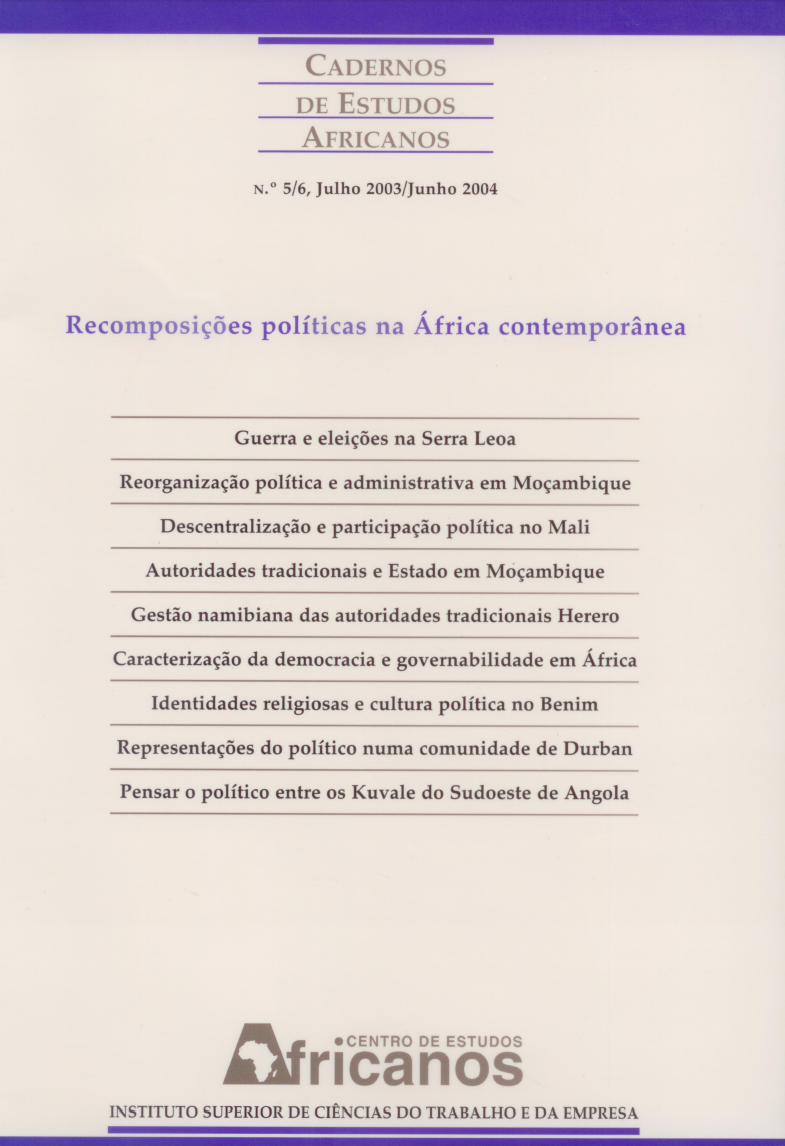
Religious identity and political culture: representations of democracy by the Pentecostal faithful in Benin
DOI:
https://doi.org/10.4000/cea.1056Keywords:
démocratie, culture politique, pentecôtisme, BéninAbstract
Adopting as framework for its analysis the expansion of the Pentecostal movements in Benin in the context of the democratisation of that country, this article is interested in the effect of religious affiliation on the political culture of the converted, especially on the representations of democracy elaborated by the believers. Based on interviews with converted béninois, it shows that their conceptions of politics are in part conditioned by their religious affiliation, emphasizing however that democracy as seen by them corresponds to principles they value and to contrasting representations. If it is true that Pentecostal affiliation does not appear to constitute an obstacle to the acceptance of democratic principles and mechanisms, the reason lies in the fact that this religious socialisation can contribute to the internalisation of the new political norms: because it offers an interpretation grid for the political transformations, and because it may, paradoxically, reveal affinities with the logics that guide the formation of a democratic public space.
Downloads
Published
Issue
Section
License
Copyright (c) 2016 Cadernos de Estudos Africanos

This work is licensed under a Creative Commons Attribution-NonCommercial-ShareAlike 4.0 International License.
I authorize the publication of the submitted article/review of which I am the author.
I also declare that this article is original, that it has not been published in any other way, and that I exclusively assign the publication rights to the journal Cadernos de Estudos Africanos. Reproduction of the article, in whole or in part, in other publications or on other media is subject to the prior authorization of the publisher Centro de Estudos Internacionais do Iscte - Instituto Universitário de Lisboa.