
South Africa and the resolution of conflicts in Africa
DOI:
https://doi.org/10.4000/cea.1354Keywords:
África do Sul, resolução de conflitos, Política externaAbstract
After the victories of the ANC and Nelson Mandela in the 1994 elections, the international community turned to South Africa in an attempt to find an African partner capable of controlling and leading not only the strategic region of Southern Africa, but the whole African continent. The way in which the transition process had occurred in South Africa, and in particular the key role civil society had played by monitoring it, was considered as a success by the international community. By virtue of the example it had given as well as of the international prestige of some of its leaders, South Africa was as a consequence as a state essential for the stabilization of an unstable continent. In this paper, the author tries to establish up to which point the expectations created with regard to the capacities of South Africa are realistic, in to what degree the international community can at this stage count on a support from South Africa for the resolution of conflicts in Africa.
References
Alex Duval Smith (1998), «Mandela Fails in Peace Initiaves», in The Mail & Guardian on-line, 4 September, 2 pp.
Alex Duval Smith (1998), «Oumsy Pretoria adds to Africa's Troubles», in The Mail & Guardian on-line, 24 September, 1 p.
Chris Alden (1993), «From Liberation Movement to Political Party: ANC Foreign Policy in Transition», in South African Journal of International Affairs, vol.1, nºl, pp. 62:81.
Department of Defence (2001), Adress by He Minister of defence, the Hon. Mosiuoa Lekota MP, on the Occadion of the Defence Budget Vote, 5 pp.
Ernest Harsch (2001), «South Africa Tackles Social Inequities», in Africa Recovery, vol.14, nº4, January, United Nations Departement of Public Information, New York, pp. 12:19.
Fred Anwireng Obeng & Patrick J. McGowan (2001), «Partner or Hegemon? South Africa in Africa», in South Africa Foreign Policy. Dilemmas of a New Democracy, edited by Jim Broderick & Gary Burford & Gordon Freer, Palgrave Publishers, New York, pp. 55-82.
Greg Mills (2000), The Wired Model. South Africa, Foreign Policy and Globalization, The South African Institute of International Affairs & Tafelberg Publishers Limited, Cape Town, 368 pp.
Jim Broderick, Gary Burford & Gordon Freer, (eds.) (2001), South Africa Foreign Policy. Dilemmas of a New Democracy, Palgrave Publishers, New York, 243 pp.
Joseph Winter (2001), «Does South Africa Hold the Key?», in BBC News on Africa, 10 September, 4 pp.
Jude Uzonwanne (1998), «Nigeria Has Spoken. Mandela Must Listen», in The Mail & Guardian on-line, 27 April, 3 pp.
Khutliso Sekoati (1998), «Racism Soaring within SANDF», in The Survivor, October 27, Maseru, 2 pp.
Mark Shaw (1995), «Negotiating Defence for a New South Africa», in About Turn. The Transformation of the South African Military and Intelligence, Institute for Defence Policy, Halfway House, pp. 9:34.
Pierre Steyn (1998), «South Africa and Peace Support Operations: Limitations, Options and Challenges», in African Security Review, Institute for Defence Policy, Pretoria, vol. 7, nº9.
Stefaans Brummer (1996), «South Africa Takes Back Seat in Zaire Crisis», in The Mail & Guardian on-line, 8 November, 4 pp.
White Paper on South African Participation in Intemational Peace Missions, Departement of Foreign Affairs,1998, 25 pp.
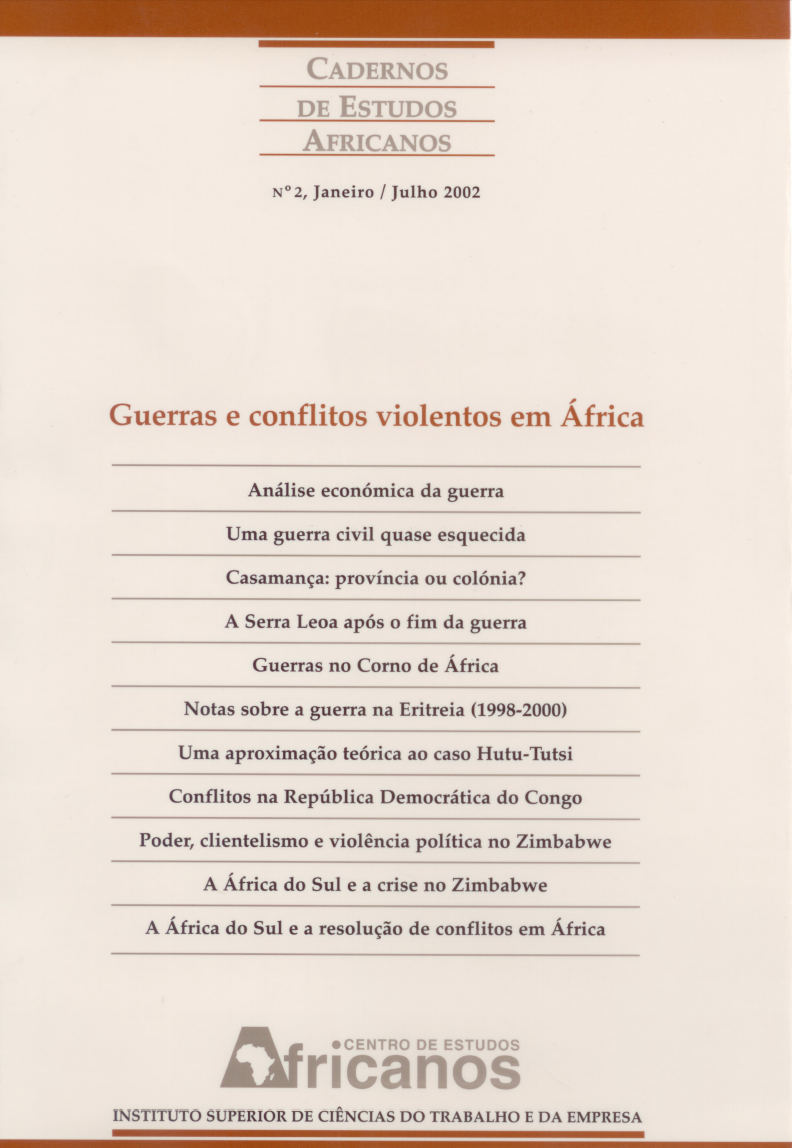
Downloads
Published
Issue
Section
License
Copyright (c) 2016 Cadernos de Estudos Africanos

This work is licensed under a Creative Commons Attribution-NonCommercial-ShareAlike 4.0 International License.
I authorize the publication of the submitted article/review of which I am the author.
I also declare that this article is original, that it has not been published in any other way, and that I exclusively assign the publication rights to the journal Cadernos de Estudos Africanos. Reproduction of the article, in whole or in part, in other publications or on other media is subject to the prior authorization of the publisher Centro de Estudos Internacionais do Iscte - Instituto Universitário de Lisboa.