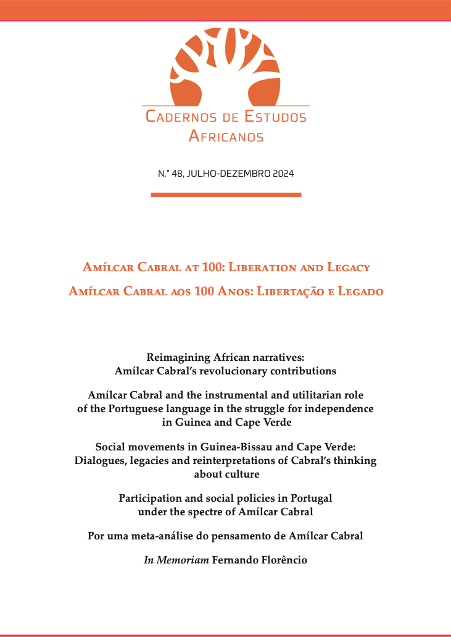
Amílcar Cabral and the instrumental and utilitarian role of the Portuguese language in the struggle for independence in Guinea and Cape Verde
DOI:
https://doi.org/10.15847/cea48.36518Abstract
The struggle for national liberation in the Portuguese colonies raised extensive debates and critical reflections regarding whether liberation movements should adopt the coloniser’s language as a tool for contesting colonialism or prioritise linguistic decolonisation as part of their resistance efforts. In the specific case of the PAIGC, the topic was the subject of multiple discussions, as evidenced by the interventions of its leader, Amílcar Cabral. Indeed, the existence of different positions regarding the matter reveals the complexity of the issue. This paper will examine Amílcar Cabral’s theoretical contributions to the sociolinguistic debate on the use of the Portuguese language by the African Party for the Independence of Guinea and Cape Verde (PAIGC). It also aims to update existing knowledge on the subject.
Downloads
Published
Issue
Section
License
Copyright (c) 2025 Cadernos de Estudos Africanos

This work is licensed under a Creative Commons Attribution-NonCommercial-ShareAlike 4.0 International License.
I authorize the publication of the submitted article/review of which I am the author.
I also declare that this article is original, that it has not been published in any other way, and that I exclusively assign the publication rights to the journal Cadernos de Estudos Africanos. Reproduction of the article, in whole or in part, in other publications or on other media is subject to the prior authorization of the publisher Centro de Estudos Internacionais do Iscte - Instituto Universitário de Lisboa.