
Cabo-Verdean musical expressions, their role and importance in the struggle for independence and after
DOI:
https://doi.org/10.15847/cea49.43058Keywords:
Cape Verde, Cape Verdean music, activist music, protest music, Guinean and Cape-Verdean independence struggles, post-independenceAbstract
Cape-Verdean musical expressions are related in different ways with the end of colonialism. The morna and the koladera were employed deliberately by activists to transmit their messages. Others, such as the batuku and the funaná were not evidently linked to the struggle. The present work shows the complexity of the relations that these musical expressions had with the political trajectory of Cape Verde. Based on interdisciplinary methodology, with emphasis on sources such as press and discography, I question the tendency, found both in current language and sometimes in academic texts, to associate the morna exclusively with the semantic field of love. I seek, at the same time, to relativize the militant attitude associated with the batuku and the funaná.
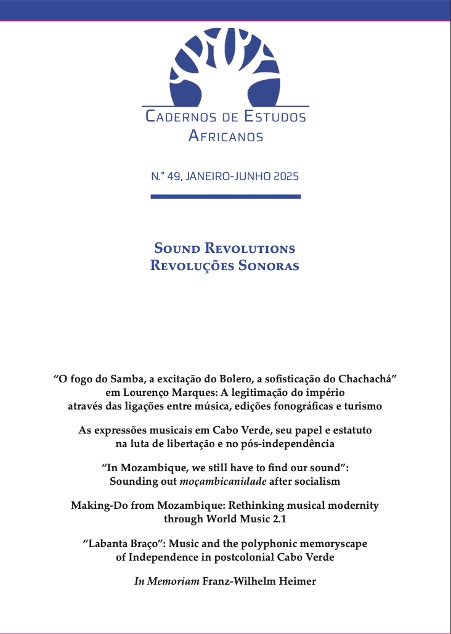
Downloads
Published
Issue
Section
License
Copyright (c) 2026 Cadernos de Estudos Africanos

This work is licensed under a Creative Commons Attribution 4.0 International License.
I authorize the publication of the submitted article/review of which I am the author.
I also declare that this article is original, that it has not been published in any other way, and that I exclusively assign the publication rights to the journal Cadernos de Estudos Africanos. Reproduction of the article, in whole or in part, in other publications or on other media is subject to the prior authorization of the publisher Centro de Estudos Internacionais do Iscte - Instituto Universitário de Lisboa.