
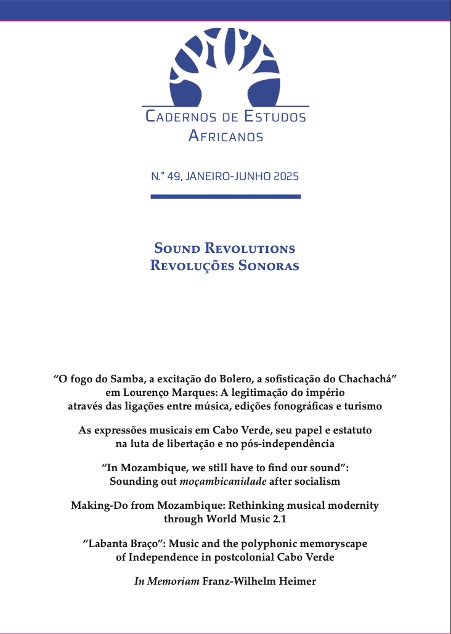
“In Mozambique, we still have to find our sound”: Sounding out moçambicanidade after socialism
DOI:
https://doi.org/10.15847/cea49.43055Keywords:
Mozambicanness, cultural nationalism, popular music, sonic politics, post-socialism, identity and belongingAbstract
This article examines the evolving sonic politics of moçambicanidade — defined as Mozambican national identity — through popular music and sound after independence. Drawing on ethnographic research, media analysis, and interviews with musicians and audiences, it explores how national identity has been sonically constructed, corporatized, and contested. The article traces the ideological legacy of FRELIMO’s post-independence project of cultural nationalism through debates over youth dance genres, like pandza, in the mid-2000s, and the increasing alignment of music with corporate and state agendas during Armando Guebuza’s presidency (2005-2015). It argues that competing interpretations of a “Mozambican sound” reveal deep class, regional, and generational tensions, and that listening has become a key site for negotiating belonging, dissent, and the limits of state-imposed unity.
Downloads
Published
Issue
Section
License
Copyright (c) 2026 Cadernos de Estudos Africanos

This work is licensed under a Creative Commons Attribution 4.0 International License.
I authorize the publication of the submitted article/review of which I am the author.
I also declare that this article is original, that it has not been published in any other way, and that I exclusively assign the publication rights to the journal Cadernos de Estudos Africanos. Reproduction of the article, in whole or in part, in other publications or on other media is subject to the prior authorization of the publisher Centro de Estudos Internacionais do Iscte - Instituto Universitário de Lisboa.