
Mobile seamless learning in Higher Education: an exploratory case study
DOI:
https://doi.org/10.34627/redvol9iss1e202602Palabras clave:
Mobile learning, Seamless learning, Higher education, FRAME model, 10-D MSL frameworkResumen
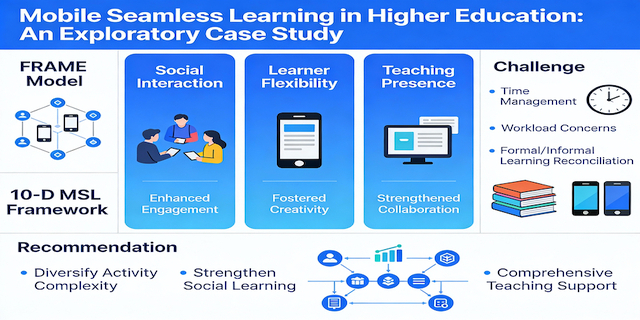
Mobile seamless learning (MSL) has emerged as a transformative pedagogical approach in higher education, offering opportunities for flexible, collaborative, and social learning. Despite growing scholarly attention, its systematic implementation as a pedagogical framework remains underexplored. This study examines the integration of MSL principles in a Masters-level distance learning course, drawing on the FRAME and 10-Dimensions MSL (10D-MSL) frameworks. A mixed-methods design combining quantitative and qualitative data was used to evaluate three dimensions: social interaction, learner flexibility, and teaching presence. Results show that the MSL-based course enhanced engagement, fostered creativity, and strengthened collaborative learning. Challenges also emerged, particularly in time management, workload, and balancing formal and informal contexts. Findings highlight the crucial role of mobile devices in enabling autonomous and context-based learning, but also the dependence on thoughtful instructional design aligned with learner needs. Well-structured course design proved essential to overcoming technical and organizational barriers. This research contributes to the understanding of MSL in higher education and offers practical guidelines for educators seeking to implement mobile technologies effectively.
Descargas
Publicado
Cómo citar
Número
Sección
Licencia
Derechos de autor 2026 Ingrid Noguera, Daniele Agostini, Ana Afonso

Esta obra está bajo una licencia internacional Creative Commons Atribución-NoComercial 4.0.
Os autores conservam os direitos de autor pelo seu trabalho e concedem à revista o direito de primeira publicação, com o trabalho simultaneamente licenciado sob uma Licença Creative Commons - Atribuição-NãoComercial 4.0 Internacional.

